
The Licinius I “Mars the Conservator” Follis (RIC VI Ticinum 121a/124a) serves as a striking bronze window into the final, fractured years of the Roman Tetrarchy. Struck around AD 310–311, this piece captures the moment Licinius—the “Iron General” of the East—was trying to anchor his legitimacy in the old gods of Rome while his rival, Constantine the Great, was already looking toward a Christian future.
At Numiscurio, we often say that a coin’s “soul” is found in its ability to project a sense of traditional order even as the very system of the Empire is being torn apart.
1. The Historical Context: The Last of the Old Guard
Licinius was the ultimate survivor. A close friend and comrade-in-arms of the Emperor Galerius, he was plucked from the military ranks and catapulted to the rank of Augustus during the Conference of Carnuntum in AD 308. His mission was to stabilize the crumbling Tetrarchy (the “Rule of Four”), but he found himself caught in a multi-front civil war.
This coin was minted during those high-stakes early years at the Ticinum mint (modern Pavia, Italy). While Constantine was beginning to experiment with new symbols in his western territories, Licinius doubled down on the classic Roman pantheon. This was more than just religion; it was a political statement. By invoking Marti Conservatori (Mars the Preserver), Licinius was telling his legions that he was the true heir to the martial traditions of Diocletian and the ancient Roman state.
Because Licinius held Ticinum during this transitional window, these coins are prized for their crisp, North-Italian style. Finding a specimen where the “reversed spear” of Mars is sharp and the shield is perfectly centered is a vital addition for any collector tracking the transition from the Pagan to the Christian Empire.
2. The Reverse: Mars the Preserver
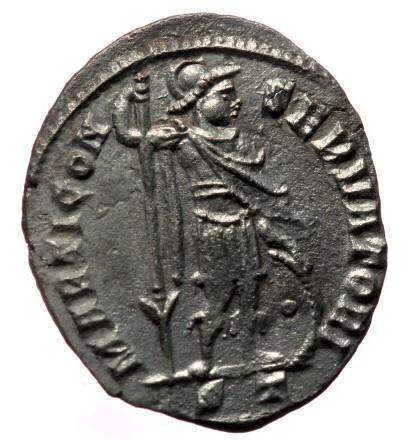
The reverse features Mars, the god of war, helmeted and cuirassed, standing front with his head turned, leaning on a reversed spear and resting his hand on a shield.
- The Guarded Peace: The “reversed spear” (point down) is a crucial symbol. It represents a soldier at rest but ready—the idea of “Peace through Strength.” It told the citizens of the Empire that while Licinius was a warrior, his goal was the preservation (Conservatori) of the Roman way of life.
- The Tetrarchic Style: Notice the stocky, powerful proportions of the figure. This is classic 4th-century art—functional, imposing, and stripped of the delicate grace of the earlier High Empire.
- The Legend: MARTI CON-SERVATORI. A direct appeal to the god of war to preserve the Emperor and his borders.
3. The Obverse: The Pannonian Soldier
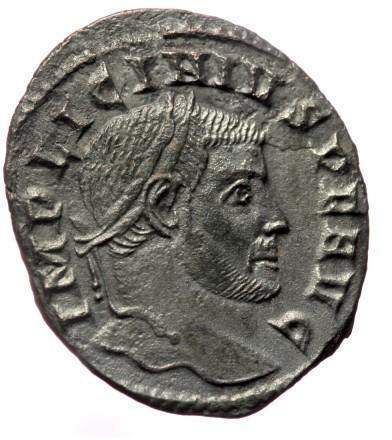
The obverse features the laureate head of Licinius, facing right.
- The Stoic General: Licinius’s portraiture is defined by a rugged, square-jawed realism. Unlike the idealized, youthful portraits of Constantine, Licinius wanted to look like the veteran Pannonian soldier he was. The short-cropped beard and the thick neck signify a man who ruled the barracks as effectively as the palace.
- The Imperial Titles: The legend identifies him as IMP LICINIVS P F AVG (Imperator Licinius Pius Felix Augustus), the standard formula for a legitimate ruler of the Roman world.
- The Legend: IMP LICINIVS P F AVG.
4. Technical Details: The Ticinum Workshop
- RIC VI Ticinum: Cataloged in Roman Imperial Coinage, Volume VI.
- The Mint: Struck in Ticinum. This mint was famous for its high-quality engraving and was a key strategic asset for whoever controlled Northern Italy. You can identify it by the mint mark in the exergue (e.g., PT, ST, or TT).
- The Follis Standard: By this time, the Follis had shrunk from the massive “Genius” coins of Diocletian’s day, but it still maintained a thin silver wash (billon). If your specimen has a slight “silvering” in the hair or the letters of the legend, it’s a sign that the coin was lost early in its life before the silver wore away.
