
The Licinius I “Jupiter the Preserver” Follis (RIC VII Cyzicus 3) serves as a striking bronze window into the high-stakes theological Cold War of the 4th century. Struck around AD 313–315, this piece captures the moment Licinius—the seasoned “Iron General” of the East—chose to anchor his throne to the King of the Gods, even as his brother-in-law and rival, Constantine, began to pivot the West toward the Christian Cross.
1. The Historical Context: The Last Stand of the Olympians
By AD 313, the Roman world was split between two titans: Constantine in the West and Licinius in the East. Though they had jointly issued the Edict of Milan, granting religious freedom, their personal ideologies were drifting dangerously apart. While Constantine was moving toward the “Chi-Rho,” Licinius remained the staunch defender of the old Roman military virtues.
This follis was minted at the Cyzicus mint (on the coast of modern-day Turkey) during the peak of this uneasy peace. By invoking Iovi Conservatori (Jupiter the Preserver), Licinius was telling the Eastern legions that the ancient order was still in charge. He wasn’t just paying his troops; he was reminding them that the “King of the Gods” was the true source of Imperial victory.
2. The Reverse: Jupiter and the Imperial Eagle
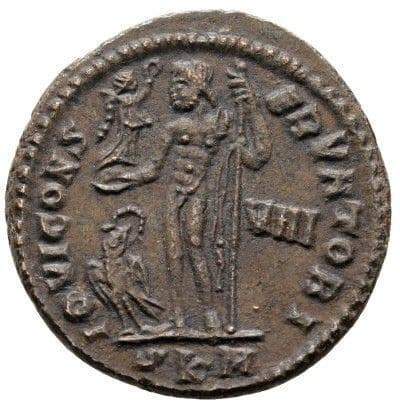
The reverse features Jupiter, nude but for a chlamys (military cloak) draped over his shoulder, standing left and leaning on a scepter while holding a small Victory on a globe.
- The Eagle’s Favor: At Jupiter’s feet, a small eagle stands with a wreath in its beak. In Roman mythology, the eagle was Jupiter’s messenger and the soul of the legion. The wreath offered by the eagle symbolizes the divine crown being handed directly to Licinius.
- Victory on a Globe: The tiny figure of Victory standing on a sphere tells the world that Licinius’s authority is global and divinely sanctioned. It is a classic “Tetrarchic” image of absolute, unquestionable power.
- The Legend: IOVI CONSERVATORI. A direct plea for the preservation of the Emperor and the state through the might of the thunderbolt-wielder.
3. The Obverse: The Veteran of the Balkans
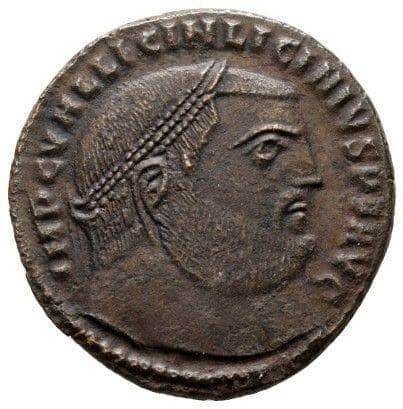
The obverse features the laureate head of Licinius, facing right.
- The Military Portrait: Licinius’s portraiture is famous for its “stubby” realism. He is depicted with a short-cropped military beard and a thick, powerful neck—the look of a man who rose through the ranks in the brutal Pannonian frontier. Unlike the increasingly idealized portraits of Constantine, Licinius wanted to look like a man you could trust in a shield wall.
- The Imperial Titles: The legend IMP LIC LICINIVS P F AVG (Imperator Licinius Pius Felix Augustus) confirms his status as a legitimate, pious, and “happy” ruler of the Roman world.
4. Technical Details: The Cyzicus Craft
- RIC VII Cyzicus 3: Cataloged in the seventh volume of the Roman Imperial Coinage, which covers the final years of the Constantinian era.
- The Mint: Struck in Cyzicus. This mint was known for its sharp, high-relief engraving. You can identify it by the mint mark in the exergue (e.g., SMK for Sacra Moneta Kyzici).
- The Silver Wash: When this coin was first struck, it was coated in a thin layer of silver (billon). Finding a specimen today with a dark, smooth patina or hints of that original silvering is a testament to the industrial scale of the Eastern mints during the civil wars.
