
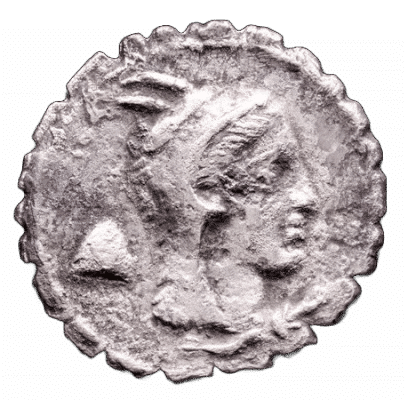
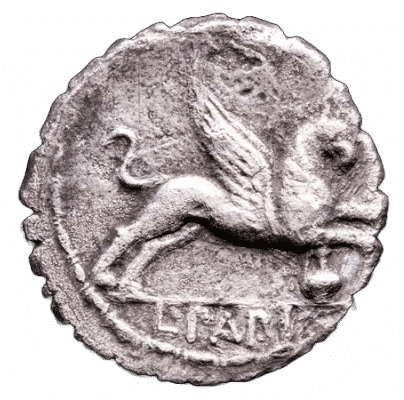
The L. Papius “Juno Sospita” Denarius (Crawford 384/1) is a masterpiece of the Roman Republic’s “Serrate” series, struck in 79 BC. This coin is a favorite among specialists not just for its mythological beauty, but for its legendary control-symbol system, which represents one of the most complex and playful “games” ever played by the Roman Mint.
At Numiscurio, we often say that a coin’s “soul” is found in its pair; every L. Papius denarius is part of a unique set of symbols that acted as a 2,100-year-old serial number.
1. The Historical Context: The Sullan Restoration
When Lucius Papius was appointed Tresvir Monetalis (Mint Master) in 79 BC, Rome was exhaling after the brutal civil wars of Sulla. The city was being rebuilt, and the old traditions were being polished. Papius belonged to a family originally from Lanuvium, a city just south of Rome that was the ancestral home of the cult of Juno Sospita.
By featuring the patron goddess of his hometown, Papius was doing more than just honoring a deity; he was rooting his family’s identity in the ancient, “authentic” soil of Latium. This was a statement of pedigree in a Rome that was rapidly changing.
2. The Obverse: The Savior Goddess
The obverse features the head of Juno Sospita, facing right. She is instantly recognizable by the goat’s skin headdress, with the horns curving back over her head and the goat’s ears visible.
- Juno the Savior: “Sospita” means “The Savior” or “The Protectress.” She was a martial goddess, often depicted with a spear and shield, acting as the divine guardian of the Roman state.
- The Control Symbol: Behind her head, your specimen features an amphora (a two-handled wine or oil jar). This is where the numismatic fun begins.
- The Serrated Edge: This denarius is a Serratus, meaning its edges were notched by the mint. While scholars still debate if this was to prevent “clipping” (shaving silver) or to show the coin wasn’t a plated forgery, it gives the piece a wonderful, tactile “gear-like” feel.
3. The Reverse: The Griffin of the Sun
The reverse features a Griffin springing right, with the legend L•PAPI in the exergue.
- The Guardian of Treasure: The griffin—part lion, part eagle—was associated in the ancient world with the guarding of gold and sacred treasures. It was also a companion of Apollo, the sun god. On a silver coin, it serves as a symbolic protector of the Republic’s wealth.
- The Matching Game: In the series of L. Papius, there are over 240 different pairs of control symbols. The symbol on the obverse (your amphora) must correspond to a related symbol on the reverse. For example, if the obverse has a hammer, the reverse might have an anvil. If the obverse has an amphora, the reverse often features a cup or a wine ladle.
4. Technical Details: The Lanuvium Connection
- Crawford 384/1: Cataloged in Michael Crawford’s Roman Republican Coinage.
- The Mint: Struck in Rome, though the iconography is purely Lanuvian.
- The Engraving Style: The Papius issues are known for their high-relief, almost “chubby” portraits of Juno and the incredibly fluid, feline movement of the griffin.
