
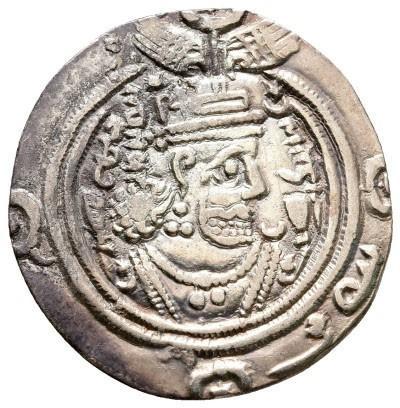
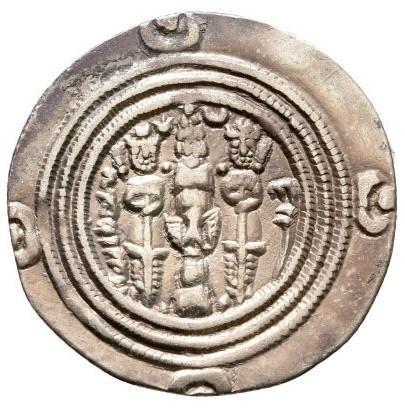
The Khusro II Silver Drachm (AD 590–628) is a massive, shimmering piece of imperial history from the final glorious chapter of the Sasanian Empire. Struck during the reign of the “Victorious King” (Aparviz), this coin represents the absolute peak of Persian power, minted at a time when Khusro’s armies were knocking on the gates of Constantinople and occupying Egypt.
At Numiscurio, we often say that a Sasanian drachm is more than just silver; it is a “cosmic map” of the Zoroastrian worldview, designed to show that the King was the center of the universe, protected by the divine glory of the heavens.
1. The Historical Context: The Last Great King of Kings
Khusro II was the last truly powerful Sasanian monarch. His reign was a rollercoaster of epic proportions: he fled his throne in a coup, was restored by the Byzantine Emperor Maurice, and then launched a massive war of “revenge” that nearly destroyed the Roman East.
This drachm was the “Global Reserve Currency” of the 7th century. It was so well-regarded for its high-purity silver and consistent weight that it circulated from the markets of Tang Dynasty China to the Viking hoards of Scandinavia. To hold this coin is to hold the wealth that built the legendary palace of Ctesiphon and funded the final, world-shattering duel between Persia and Byzantium.
2. The Obverse: The Crown of Glory
The obverse features the Bust of Khusro II, facing right. He wears an incredibly complex mural crown, which is a masterpiece of Sasanian symbolism.
- The Wings of Victory: The two wings represent Verethragna, the Zoroastrian god of Victory. They signal that the King is divinely empowered to crush his enemies.
- The Star and Crescent: These are placed atop the crown and in the margins. They identify the King as a “Cosmic Ruler,” whose authority is mirrored by the sun, moon, and stars.
- The Pahlavi Legend: To the right of his face, his name Khusro is written in the Middle Persian (Pahlavi) script. To the left is the phrase GDH ‘p’zwt (“May the Royal Glory increase”).
3. The Reverse: The Eternal Flame
The reverse features the central icon of the Zoroastrian faith: the Fire Altar (Atar).
- The Two Attendants: Flanking the altar are two figures, often interpreted as the King and a priest, or two aspects of the royal soul, standing guard over the sacred flame.
- The Ribbons: Notice the heavy ribbons flowing from the column of the altar; these represent the Khvarenah, the divine grace that flows from the fire to the people.
- The Celestial Witnesses: Above the altar, a star (left) and crescent (right) witness the holy ritual.
- The Mint and Date: On the right side of the altar is the Mint Mark (an abbreviation of the city), and on the left is the Regnal Year. Khusro II reigned for 38 years, so your coin captures a specific moment in his long struggle for dominance.
4. Technical Details: The “Broad Flan” Standard
- The Size: Khusro II’s drachms are famous for being “broad and thin.” The silver was hammered out to a wide diameter (often 30-33mm) to allow for the elaborate margin decorations.
- The Purity: The Sasanians maintained a legendary silver purity (often over 95%). This made the coins highly desirable for international trade and led to them being imitated by the early Islamic Caliphates for decades after the fall of the empire.
- The Collector’s “Tell”: Look for the detail in the King’s beard and the individual flames on the altar. Finding a specimen where the star-in-crescent margins are not clipped and the Pahlavi date is clear is the mark of a top-tier Persian collection.
