

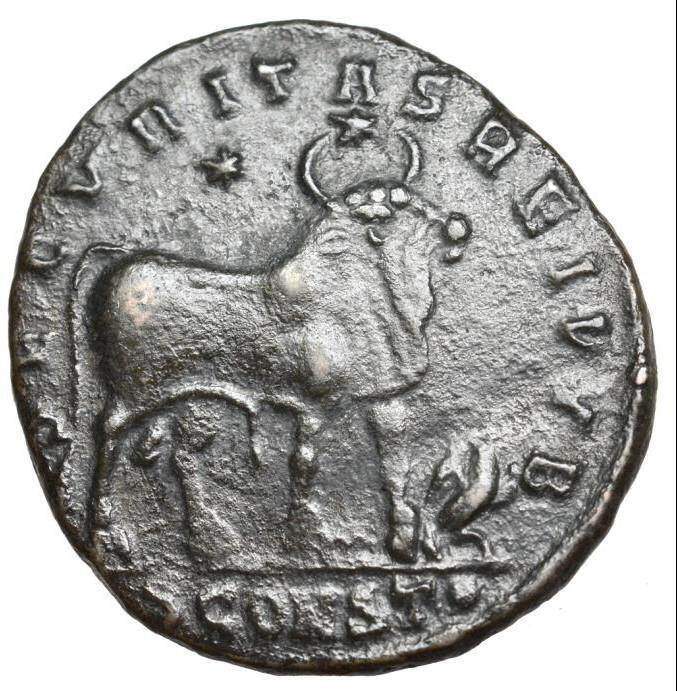
If you are looking for a coin that represents a “Last Stand” against the tide of history, the Julian II “The Apostate” Maiorina (RIC VIII Antioch 216 / RIC 320) is a masterpiece of defiance. Struck around AD 361–363, this large bronze piece is one of the most provocative coins ever minted in the Roman Empire.
1. The Historical Context: The Philosopher-Rebel
Julian was the nephew of Constantine the Great, but he was nothing like his Christian uncle. Having survived a family massacre as a child, he grew up in secret, falling in love with the forbidden philosophy and gods of Ancient Greece.
When he was proclaimed Emperor by his troops, he did the unthinkable: he “apostatized,” or turned his back on Christianity. He reopened the pagan temples, trimmed the bloated imperial court, and tried to drag the Empire back to its classical, polytheistic roots. This coin was his primary tool for announcing this “Pagan Renaissance” to a shocked Roman world.
2. The Reverse: The Sacred Apis Bull
The reverse features a massive, powerful Bull standing right, with two stars above its back.
- The Mystery of the Bull: Scholars have debated this image for centuries. Is it the Apis Bull of Egypt, signaling Julian’s respect for ancient mystical traditions? Or is it a symbol of a sacrificial victim, ready to be offered to the gods to ensure victory against the Persians?
- The Stars: The two stars represent the Dioscuri (Castor and Pollux), the divine twins who protect the state, or perhaps the celestial favor Julian believed he possessed as a student of the stars.
- The Legend:
SECURITAS REIPVB(The Security of the Republic). It was a bold claim: Julian was arguing that true security came not from the “new” god, but from returning to the old ways.
3. The Obverse: The Philosopher’s Beard
The obverse features the bust of Julian II, wearing a pearl diadem. But it’s his face that tells the real story.
- The Beard: For over 50 years, Roman Emperors had been clean-shaven in the style of Constantine. Julian grew a long, flowing “Philosopher’s Beard” to link himself to great thinkers like Marcus Aurelius and the Greek sages.
- The “Antioch” Connection: Julian spent much of his reign in Antioch (the mint for RIC 320) preparing for war. The citizens of Antioch, who were largely Christian and loved the theater, mocked his beard and his “old-fashioned” ways. Julian responded by writing a famous satire called the Misopogon (“Beard-Hater”).+1
- The Legend:
D N FL CL IVLIANVS P F AVG.
4. Technical Details: The “Maiorina”
- RIC VIII Antioch 216 / 320: Cataloged in Roman Imperial Coinage, Volume VIII.
- The Large Format: Julian introduced this large bronze denomination (the Maiorina) to give his propaganda a bigger “canvas.” These coins are significantly larger and heavier than the tiny bronze pieces of his predecessors.
- The Mint Mark: Look at the bottom (exergue) for CONST (Constantinople), often followed by letters like A, B, or Γ, marking the specific workshop that struck this defiant piece of history.
