
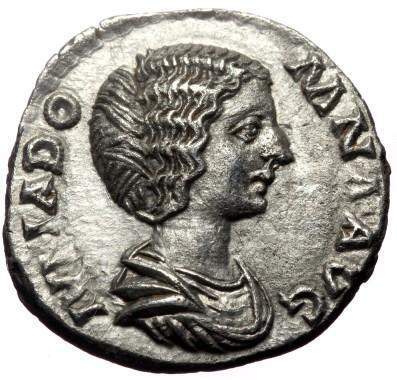
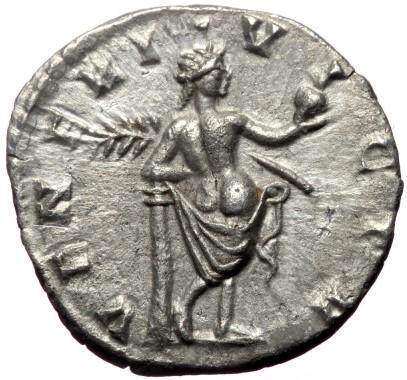
The Julia Domna Denarius (RIC IV 536) is a masterpiece of Severan propaganda, struck between AD 193 and 196. It represents a high point in Roman engraving and a bold statement about the power of the Imperial family during a time of civil war.
1. The Historical Context: The Syrian Empress
Julia Domna was one of the most powerful women in Roman history. A daughter of the high priest of the sun god Elagabalus in Emesa, Syria, she married Septimius Severus years before he became emperor.
When Severus seized the throne in AD 193 (the “Year of the Five Emperors”), he faced rivals in both the East and West. This coin was minted during those early, uncertain years. Julia Domna wasn’t just a wife; she was the “Mother of the Camp” (Mater Castrorum). This coin served to soften the image of the militaristic Severan dynasty by focusing on divine grace, beauty, and the promise of a new, fertile lineage.
2. The Reverse: Venus Victrix (Venus the Victorious)
The reverse of RIC 536 is famous among collectors for its artistic and slightly risqué composition. It depicts Venus Victrix from behind, with her drapery falling below her hips, exposing her back.
- The Pose: Venus leans her left elbow on a column, holding an apple (the prize from the Judgment of Paris) and a palm branch (the symbol of victory).
- The Message: By associating Julia Domna with Venus Victrix, the mint was making a specific political claim. Venus was the mythical ancestress of the Roman people (through Aeneas). This coin argued that victory belonged to the Severan family not just through the sword, but through divine right and the “conquering” power of beauty and harmony.
- The Legend:
VENERI VICTR(To Venus the Victorious).
3. The Obverse: The Iconic Severan Portrait
The obverse features a draped bust of Julia Domna with her most recognizable feature: her elaborate, heavy wig.
- The Legend:
IVLIA DOMNA AVG. - The Hair: Julia Domna set the fashion for the empire. Her hair is styled in deep, horizontal waves, tucked into a large “bun” or “chignon” at the back of her head. In numismatics, the precision of these waves is often used to judge the quality of the die-sinker.
4. Technical Details
- RIC IV 536: Cataloged in Roman Imperial Coinage, Volume IV, Part I (the section dedicated to Septimius Severus).
- Mint: Struck at the Rome mint.
- Silver Purity: Under Septimius Severus, the silver content of the denarius began to drop (to about 45-50%). However, the coins of Julia Domna often retained a high-quality “shimmer” and were struck on slightly wider flans than later 3rd-century issues.
