
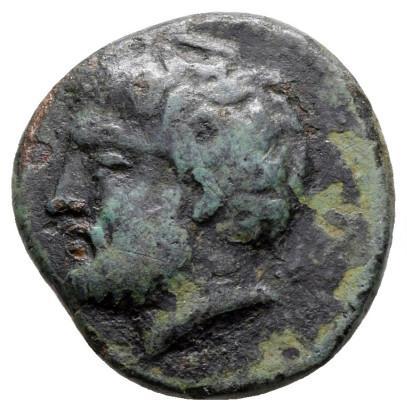
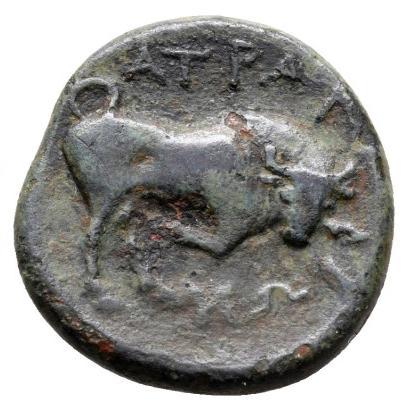
The Thessalian “Butting Bull” Bronze (SNG Copenhagen 27) is a rugged, spirited piece of regional history from the heart of ancient Greece. Struck between 400–344 BC at the river-city of Atrax, this coin captures the essence of the Thessalian plains—a land famous not for philosophers or sailors, but for the finest cavalry and the most powerful livestock in the Hellenistic world.
At Numiscurio, we often say that a coin’s “soul” is found in its local pride; to hold a bronze from Atrax is to touch the identity of a people who lived at the crossroads of the Peneios River and the great mountain passes.
1. The Historical Context: The Gateway of the Peneios
Atrax was a strategic stronghold in the Pelasgiotis district of Thessaly, perched on the banks of the Peneios River. It was named after the mythical hero Atrax, a son of the river-god Peneios. In the 4th century BC, while Athens and Sparta were exhausting themselves in endless wars, the cities of Thessaly were thriving through their vast agricultural wealth and their legendary horse-breeding.
This bronze issue was struck during a period of intense civic competition. By minting their own coins, the people of Atrax were declaring their independence from the larger Thessalian powers like Larissa. They chose symbols that spoke to their land: the founder-hero who protected them and the bull that represented their economic muscle.
2. The Obverse: The Heroic Founder
The obverse features the Bearded Head of Atrax, facing left.
- The Fillet of Honor: He is shown “bound with a fillet” (a simple cloth headband). This wasn’t a crown for a king, but a mark of athletic or religious distinction. It portrays the city’s namesake as a dignified, mature leader—a protector of the river valley.
- The Dotted Border: The fine, beaded border framing the head is a hallmark of the 4th-century Thessalian style. It gives the coin a “medallic” quality, showing that even smaller cities employed highly skilled die-engravers.
3. The Reverse: The Power of the Plains
The reverse features a bull butting right, a classic and dynamic image of raw energy.
- The Butting Bull: In Thessaly, bulls were more than just livestock; they were central to the culture. The region was famous for the Taurokathapsia (bull-leaping or bull-fighting festivals). The “butting” pose—head down, horns ready—symbolized the defensive strength of the city and the virility of its land.
- The Ethnic: The legend ATRAΓΙ / ΩΝ (Atragion) translates to “Of the People of Atrax.” It is split above and below the bull, anchoring the animal to the city’s name.
4. Technical Details: The Thessalian Strike
- SNG Copenhagen 27: Cataloged in the Sylloge Nummorum Graecorum, representing the world-class collection in Denmark.
- The Mint: Atrax. While rarer than the coins of nearby Larissa, Atrax bronzes are prized for their heavy, thick flans and their earthy, honest depictions of Greek life.
- The Patina: These bronzes often develop a stunning, dark “forest green” or a deep, “river-silt” black patina.
- The Collector’s “Tell”: Look for the detail in the bull’s musculature and the individual locks of the hero’s beard. Finding a specimen where the horns of the bull are sharp and the “A” in the legend is clear is a major highlight for any specialist of the Northern Greek world.
