
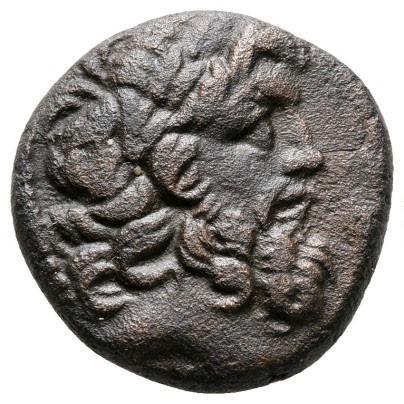
The Antioch “Zeus Nikephoros” Bronze (HGC 9, 1370-1) is a heavy, authoritative piece of civic history from the “Golden City” of the East. Struck during the 1st century BC at the bustling mint of Antioch ad Orontem, this coin represents the final, turbulent years of the Seleucid Empire and the dawn of Roman influence in Syria.
1. The Historical Context: The Metropolis of the East
By the mid-1st century BC, the once-mighty Seleucid Empire was a shadow of its former self, torn apart by dynastic infighting. However, the city of Antioch remained a titan. It was the Metropolis (Mother-City)—a cosmopolitan melting pot where Greek culture, Syrian tradition, and Roman ambition collided.
This coin was struck as a “Civic Issue.” Unlike the coins of earlier kings, which focused on the royal portrait, these issues emphasize the city’s own identity. The legend proudly proclaims its status as a “Metropolis,” signaling to the ancient world that even as kings fell, the city of Antioch remained an eternal, self-governing power.
2. The Obverse: Zeus the Father
The obverse features a magnificent Laureate Head of Zeus, facing right.
- The High Classical Style: Notice the thick, flowing beard and the laurel wreath. This is Zeus in his role as the supreme protector of the city. The engravers at Antioch were masters of the “High Hellenistic” style, giving the god a sense of weathered, majestic wisdom.
- The Symbol of Authority: In a time of political chaos, the image of Zeus provided a sense of divine stability. He was the ultimate “fixed point” for a citizenry that had seen too many kings come and go.
3. The Reverse: Zeus the Victory-Bringer
The reverse features Zeus Nikephoros (Zeus the Victory-Bringer) seated left on a high-backed throne.
- The Nike in Hand: Zeus holds a tiny, winged Nike (the goddess of Victory) in his outstretched right hand. This symbolizes that all victory on earth flows from the hand of the king of the gods.
- The Cornucopia: To the left of Zeus, you’ll find a cornucopia (the horn of plenty). This was the signature of Antioch’s wealth—a city fed by the rich Orontes valley and the endless trade of the Silk Road.
- The Legend: ANTIOXΕΩN THΣ / MHTPOΠOΛEΩΣ (Antiocheon tes Metropoleos — “Of the Antiochians, the Metropolis”). This legend is a bold claim of civic pride and regional dominance.
- The Date: Look in the exergue (the bottom) or the fields for a Greek numeral. These dates are often calculated from the Seleucid Era (starting in 312 BC) or the Caesarean Era, allowing us to pin down the exact year your coin saw the streets of the city.
4. Technical Details: The Weight of the East
- HGC 9, 1370-1: Cataloged in the Handbook of Greek Coinage, the primary modern reference for Seleucid and Syrian issues.
- The Mint: Antioch. As one of the most productive mints in history, Antioch produced bronzes with a distinctive “heavy” feel and a high level of artistic consistency.
- The Patina: These Syrian bronzes often develop a stunning, “desert” sandy patina or a deep, dark “chocolate” brown.
- The Collector’s “Tell”: Look for the detail in the feathers of Nike’s wings and the individual fruits in the cornucopia. Finding a specimen where the throne’s legs are clearly engraved is the mark of a well-centered and highly desirable civic piece.
