
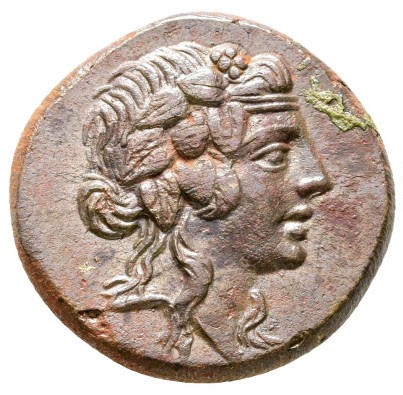
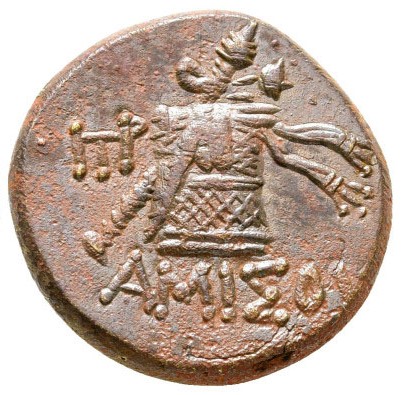
The Amisos “Cista Mystica” Bronze (SNG Black Sea 1200) is a powerful piece of visual warfare from the Kingdom of Pontos. Struck between 120–63 BC at the thriving port of Amisos (modern-day Samsun, Turkey), this coin represents the height of the “Mithridatic Wars”—a period when a single Eastern king challenged the absolute might of the Roman Republic.
1. The Historical Context: The Rome-Slayer
Mithridates VI was one of Rome’s most formidable and terrifying enemies. Famous for his lifelong immunity to poison (achieved by taking small daily doses—a practice still called “Mithridatism”), he sought to unite the Greek East against Roman taxation and expansion.
By striking this coin in Amisos, his primary naval base and a major center of Hellenic culture, Mithridates was signaling his deep connection to the Greek world. He didn’t just want to be a King of Pontos; he wanted to be the New Dionysos, the “Liberator” who would drive the Roman “barbarians” back into the sea.
2. The Obverse: The Young God of Wine
The obverse features the Head of Mithridates VI as young Dionysos, facing right. He wears an elaborate wreath of ivy and fruit.
- The Divine Likeness: Notice the features—it is a blend of the god Dionysos and the King himself. By portraying himself as the god of wine, transformation, and liberation, Mithridates was tapping into a powerful “cult of personality.”
- The Ivy Wreath: Ivy was sacred to Dionysos, representing eternal life and the “intoxicating” power of his movement. For a Greek living under Roman rule, this image was a promise of a return to a “Golden Age” of Greek independence.
3. The Reverse: The Mysteries of the Cista
The reverse features a cista mystica—a sacred basket used in the mystery cults of Dionysos—draped with a panther skin and resting behind a thyrsos.
- The Cista Mystica: These baskets were said to contain sacred objects (and often live snakes) used in secret religious rites. It represents the “Hidden Power” of the Dionysian mysteries.
- The Panther Skin: The panther was the mount of Dionysos, symbolizing the wild, untamed nature of the god.
- The Thyrsos: A staff topped with a pine cone and wrapped in ivy, the ultimate symbol of Dionysian authority.
- The Legend: ΑΜΙΣΟΥ (Amisou — “Of Amisos”). This identifies the city as a loyal stronghold of the Mithridatic cause.
4. Technical Details: The Pontic Bronze
- The Mint: Amisos. This city was the intellectual and military heart of the Pontic Kingdom. Its coins are noted for their bold, high-relief style and excellent metal quality.
- The Symbolism: Everything on this coin screams “Anti-Roman.” While Rome favored austere, civic imagery, Mithridates favored the lush, mystical world of the Greek gods.
- The Patina: Pontic bronzes often develop a stunning, “river” green or a deep, “desert” sandy patina.
- The Collector’s “Tell”: Look for the detail in the grapes and ivy leaves on the obverse. Finding a specimen where the spots on the panther skin are still visible on the reverse is a sign of a premier Mithridatic collection.
