
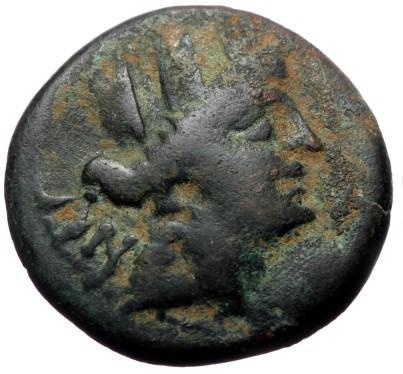
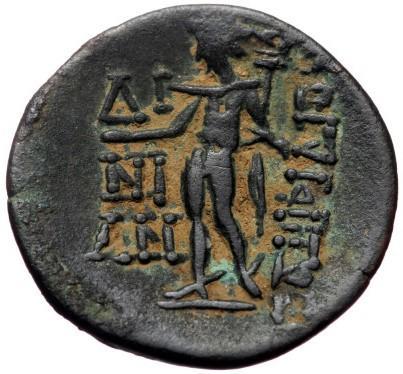
The Corycus “Hermes the Merchant” Bronze (SNG France 1086-1093 var.) is a brilliant piece of maritime history from the rugged coast of Cilicia (modern-day Turkey). Struck during the 1st century BC, this coin represents the golden age of one of the Mediterranean’s most famous “hidden” harbors—a city tucked between the sea and the spectacular “Corycian Cave” of Greek myth.
At Numiscurio, we often say that a coin’s “soul” is found in its commerce; to hold a bronze from Corycus is to touch the wealth of the ancient saffron trade and the daring spirit of the Cilician sailors.
1. The Historical Context: The Saffron Port
Corycus was more than just a port; it was a strategic stronghold situated on a rocky promontory. The city was world-renowned for its saffron (the Crocus corycius), which was considered the finest in the ancient world. This wealth allowed the city to maintain a high degree of autonomy, even as the Seleucid Empire crumbled and the Romans began to assert their dominance.
This coin was struck during a period of transition. The city was a vital link in the trade routes between the East and the West, serving as a haven for merchants and, occasionally, a base for the infamous Cilician pirates. By featuring Hermes, the god of travelers and trade, the city was signaling its identity as a premier destination for international business.
2. The Obverse: Tyche and the City Walls
The obverse features the Turreted Head of Tyche, facing right.
- The Mural Crown: Notice the crown—it is shaped like the defensive walls and towers of the city. Tyche was the goddess of fortune and the protector of the polis. By wearing the city walls on her head, she symbolized the safety and prosperity of Corycus.
- The ΛN Mark: Behind her head, the Greek letters ΛN serve as a control mark or a date, identifying the specific administrative cycle or the magistrate overseeing the minting during this prosperous era.
3. The Reverse: Hermes, the Divine Businessman
The reverse features Hermes standing facing, with his head turned left. This is one of the most detailed depictions of the god on Cilician coinage.
- The Purse and Caduceus: Hermes holds a purse in his right hand—symbolizing the profit and wealth of the saffron trade—and the caduceus (the herald’s staff) in his left, representing his role as the messenger of the gods and the protector of travelers.
- The Legend: KOPYKIΩTΩN (Korykioton) translates to “Of the People of Corycus.”
- The Magistrate’s Mark: To the left, the letters ΔI/NI/AN represent the names of the local officials responsible for the coin’s integrity. These multi-line monograms are a hallmark of the high-quality civic issues from the Cilician coast.
4. Technical Details: The Cilician Bronze
- SNG France 1086-1093 var.: This variant is cataloged in the Sylloge Nummorum Graecorum (France), a prestigious reference for the coins of Asia Minor.
- The Mint: Corycus. The mint here was known for its sharp, elegant engraving, often rivaling the much larger mints of Tarsus or Antioch.
- The Patina: These coastal bronzes often develop a beautiful, “sea-green” or deep “earthy” brown patina.
- The Collector’s “Tell”: Look for the detail in the wings on Hermes’ sandals (if visible) or the individual turrets on Tyche’s crown. Finding a specimen where the magistrate’s letters (ΔI/NI/AN) are fully legible is a sign of a well-preserved and historically significant civic piece.
