
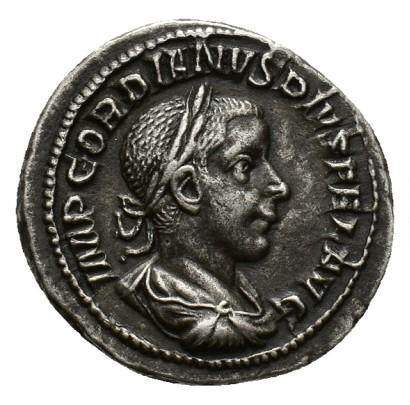
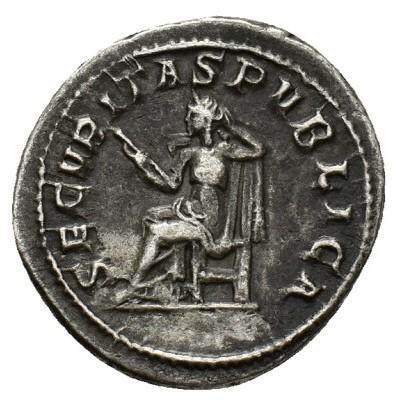
The Gordian III “Public Security” Denarius (RIC IV 130) serves as a poignant silver window into the fragile optimism of the mid-3rd century. Struck around AD 240, this coin features the “Boy Emperor” at a time when his administration—led by the capable advisor Timesitheus—was trying to convince a weary Roman public that the chaos of the “Year of the Six Emperors” was finally over.
1. The Historical Context: The Boy on the Throne
Gordian III was only 13 years old when he was catapulted to the throne by the Praetorian Guard, making him the youngest sole legal Roman Emperor in the united empire’s history. Unlike the grizzled soldier-emperors who preceded him, Gordian was a symbol of legitimacy and continuity for the Senate.
This denarius was minted during the “calm before the storm.” It was a piece of high-stakes political messaging: while the Sassanid Persians were massing on the Eastern frontier, the Roman mint was flooding the streets with images of Securitas (Security). It was a visual sedative, promising the Roman citizen that even with a teenager at the helm, the state was as stable and relaxed as the goddess on the reverse.
2. The Reverse: The Relaxed Goddess
The reverse features Securitas, the personification of the Empire’s safety, draped and seated left on a throne. She holds a scepter and, most distinctively, props her head on her left hand in a pose of total nonchalance.
- The Pose of Confidence: The “elbow-on-throne” gesture is one of the most famous in Roman numismatics. It signals securitas in its purest form—a state of being so safe that one can actually afford to be bored or drowsy.
- The Scepter of Power: Despite her relaxed posture, the scepter reminds the viewer that this security is backed by the absolute authority of the Emperor.
- The Legend: SECVRITAS PVBLICA. This was an appeal to the collective; it wasn’t just the Emperor’s security, but the “Public Security” of every Roman citizen.
3. The Obverse: The Adolescent Augustus
The obverse features the laureate, draped, and cuirassed bust of Gordian III, facing right.
- The Youthful Realism: Notice the soft, rounded features of the face. Unlike the rugged, “blocky” portraits of the later 3rd century, Gordian’s early coins capture his transition from a boy to a young man. He is shown with the “bowl” haircut typical of the era, signaling his connection to the traditional Roman military.
- The Pious and Happy Titles: The legend IMP GORDIANVS PIVS FEL AVG (Imperator Gordianus Pius Felix Augustus) highlights his “Piety” (duty to the gods and state) and his “Happiness” (divine favor).
- The Legend: IMP GORDIANVS PIVS FEL AVG.
4. Technical Details: The Last High-Quality Denarii
- RIC IV 130: Cataloged in the fourth volume of Roman Imperial Coinage, which covers the tumultuous mid-3rd century.
- The Mint: Struck in Rome. During Gordian’s reign, the Rome mint was producing coins of exceptional artistic quality. The dies are often quite sharp, capturing fine details in the folds of Securitas’s gown.
- The Denarius vs. Antoninianus: While the “double-denarius” (Antoninianus) was becoming the dominant coin of the era, Gordian continued to strike traditional Denarii like this one in significant numbers. They are often found in high grades because they were frequently hoarded as the silver content of Roman money began its final, steep decline.
