

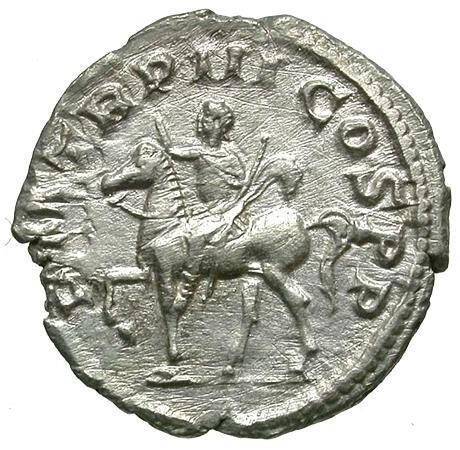
If you are looking for a coin that captures the “Cavalry Charge” of a dying era, the Gordian III Denarius (RIC IV 81) is a high-speed masterpiece. Struck around AD 240, this silver piece represents the last true “Silver Age” of the Roman Empire before the economic collapse of the late 3rd century.
At Numiscurio, we often talk about the “Soul of the Coin,” and this denarius practically vibrates with the sound of hooves and the dust of the Eastern frontier.
1. The Historical Context: The Boy on the Warhorse
In AD 240, Gordian III was barely 15 years old. He had been thrust onto the throne during the “Year of the Six Emperors”—a period of such violent turnover that the Roman people were desperate for a symbol of continuity.
This coin was minted during a rare moment of optimism. Gordian’s brilliant father-in-law, Timesitheus, had just been appointed as his chief advisor and Praetorian Prefect. Together, they were preparing a massive military strike against the Sassanid Persian Empire. This denarius was the “propaganda in the pocket” of the legionaries, showing them that their young leader wasn’t just a child in a palace, but a commander on a horse, ready to lead them into Persia.
2. The Reverse: The Emperor in Motion
The reverse of RIC 81 features a dynamic and rare scene for this era: the Emperor on horseback, pacing left, raising his right hand in a gesture of greeting or command (adlocutio), and holding a scepter in his left.
- The Symbolism: The horse represented the Equites (the Roman knightly class) and the mobility of the Imperial office. By AD 240, an Emperor could no longer stay in Rome; he had to be “in the field.”
- The Gesture: The raised hand was a sign of Clementia (Mercy) or Providentia (Foresight). It told the provinces that even though the Emperor arrived with an army, he came to restore order, not just to conquer.
- The Legend:
P M TR P III COS P P. These titles (Pontifex Maximus, Tribune for the 3rd time, Consul) allow us to date this coin perfectly to the transition between AD 240 and 241.
3. The Obverse: The Last of the “Good” Silver
The obverse features the laureate and draped bust of Gordian III.
- The Portrait: Gordian has one of the most recognizable faces in numismatics—large, soulful eyes, a slightly upturned nose, and a youthful, almost gentle expression. It is a haunting image when you realize he would be dead by age 19, likely murdered by his own successor, Philip the Arab.
- The Legend:
IMP GORDIANVS PIVS FEL AVG.- PIVS FEL: The Pious and Blessed. This was the essential “marketing” for any 3rd-century ruler trying to prove the gods hadn’t abandoned Rome.
4. Technical Details: The “End of the Denarius”
- RIC IV 81: Cataloged in Roman Imperial Coinage, Volume IV, Part III.
- The Silver Purity: Gordian III was the last emperor to strike the silver denarius in significant quantities. Shortly after this coin was minted, the “double denarius” (the Antoninianus) became the standard, and the silver purity began to plummet.
- The Strike: Gordian’s denarii are known for their high technical quality. The dies were often engraved with a fine, delicate touch that makes the “Horseback” scene look almost like a miniature relief sculpture.
