
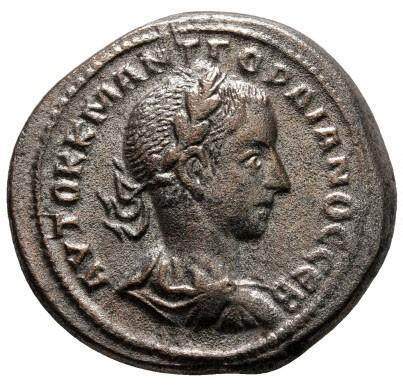
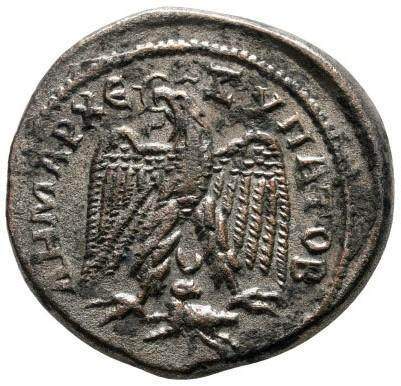
The Gordian III “Ram and Crescent” Tetradrachm (Prieur 298) is a massive, high-relief silver treasure from the Roman East. Struck around AD 241–242 in the legendary city of Antioch ad Orontem (modern-day Turkey/Syria), this coin represents the final “Grand Tour” of a boy-emperor who was destined to become the last light of the early Roman Empire before it descended into a century of darkness.
1. The Historical Context: The Persian War Issue
Gordian III was only thirteen when he was proclaimed Emperor, a child caught in the middle of a brutal struggle for power. By AD 241, the Sassanid Persian King Shapur I had invaded Mesopotamia, threatening the very heart of the Roman East. Gordian, led by his brilliant father-in-law Timesitheus, marched from Rome to Antioch to personally lead the counter-offensive.
This coin was struck at Antioch specifically to fund the massive “Great Persian War.” It was the “war-chest” currency, paid out to the elite legions massing on the banks of the Euphrates. The silver used for these coins was of a higher standard than the debased antoniniani circulating in Rome, a necessary “bonus” to ensure the loyalty of the Eastern troops.
2. The Reverse: The Eagle and the Syrian Ram
The reverse features the iconic Eagle standing facing, wings spread wide, holding a wreath in its beak. However, the true “soul” of this coin is the small, active scene between its legs: a ram running right beneath a crescent moon.
- The Eagle of the Legions: The eagle was the supreme symbol of Jupiter and the Roman state, but in the East, it also carried the weight of the sun-god Ba’al. It represents the Roman military eagle watching over the province.
- The Zodiac of Antioch: The ram (Aries) was the zodiacal symbol of the city of Antioch. By placing the ram under the protection of the eagle, the mint was making a clear statement: Rome protects Antioch.
- The Crescent Moon: This symbol is often associated with the local moon goddess, Selene or Astarte, further blending Roman authority with the ancient religious fabric of Syria.
- The Legend: DHMARC EX UPA TO B (The Greek equivalent of Tribunicia Potestate, Consul II).
3. The Obverse: The Heroic Perspective
The obverse features the laureate, draped, and cuirassed bust of Gordian III, facing right.
- The “Rear-View” Portrait: Notice that the bust is seen “from behind.” This was a deliberate artistic choice used to emphasize the Emperor’s military readiness. It shows off the intricate details of his cuirass (breastplate), reminding the soldiers that their young leader was armored and ready for battle.
- The Adolescent Emperor: The portrait captures Gordian as a young man of roughly seventeen, with short-cropped hair and the soft, almost tragic features of a youth whose reign was cut short in its prime.
- The Legend: AUTOK K M ANT GORDIANOS SEB (Autokrator Kaisar Markos Antonios Gordianos Sebastos).
4. Technical Details: The Antiochene Strike
- Prieur 298: Cataloged by Michel Prieur in the definitive guide to Syrian silver.
- The Mint: Antioch. The Antiochene engravers were masters of high relief. Unlike the flatter coins of Rome, these Tetradrachms have a “medallic” quality, with the eagle and portrait nearly jumping off the surface of the coin.
- The Metal: These coins were struck in “Billon”—a silver-copper alloy—but in the early 240s, the silver content was still high enough to maintain a bright, lustrous finish.
- The Collector’s “Tell”: Look for the detail in the feathers of the eagle and the legs of the running ram. Finding a specimen where the ram’s horns and the crescent moon are sharp and distinct is a major highlight for any specialist of the Roman East.
