
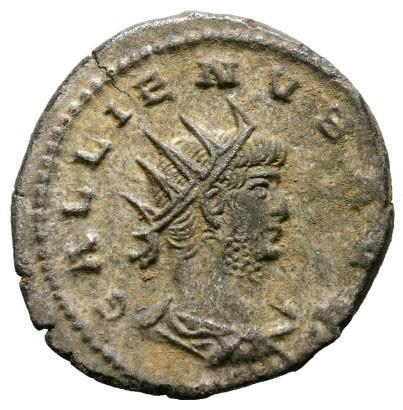
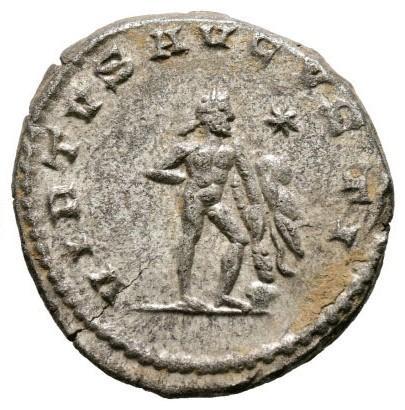
The Gallienus “Hercules the Defender” Antoninianus (RIC V 672) is a defiant piece of silver-washed propaganda from the absolute nadir of the 3rd Century Crisis. Struck around AD 260–268 at the bustling mint of Antioch, this coin represents a desperate attempt to project strength while the Roman world was literally splitting at the seams.
1. The Historical Context: The Lone Emperor
By the time this coin was struck, Gallienus was facing a nightmare. His father, Valerian, had been captured by the Persians—the ultimate humiliation for Rome. To the West, the Gallic Empire had broken away; to the East, the Palmyrene Empire was rising. Gallienus was left to hold the center alone.
By invoking Hercules on his coinage, Gallienus was reaching for the ultimate symbol of endurance and labor. He wasn’t just claiming to be a leader; he was claiming to be a “Roman Hercules,” a man tasked with the impossible labor of holding the world together. The Antioch mint was a frontline workshop, churning out these coins to pay the Eastern legions who were the only thing standing between the Roman heartland and the Sassanid King Shapur I.
2. The Reverse: The Labors of Virtus
The reverse features Hercules, the demigod of strength, standing right. He holds his iconic club in his right hand and the Nemean lion-skin over his left arm.
- Virtus Augusti: The legend VIRTVS AVGVSTI (The Valor of the Augustus) is a bold claim. In the mid-3rd century, “Virtus” didn’t just mean “virtue” in the modern sense—it meant military courage, manliness, and the physical power to defeat enemies.
- The Club of Order: The club was the weapon Hercules used to slay monsters. On this coin, it symbolizes Gallienus’s role as the “Monster-Slayer” of the Roman state, striking down usurpers and barbarian invaders alike.
- The Lion-Skin: A trophy of his first labor, representing the skin that no weapon could pierce. It signaled that the Emperor’s defenses were divinely protected and impenetrable.
3. The Obverse: The Radiate Warrior
The obverse features the radiate and cuirassed bust of Gallienus, facing right.
- The Radiate Crown: The spikes represent the rays of the sun, identifying the Emperor with Sol Invictus. This crown also marked the coin as an Antoninianus, theoretically worth two denarii, though by this time the silver content was rapidly vanishing.
- The Cuirassed Bust: Unlike his earlier, more “civilian” portraits, Gallienus is shown here in full cuirass (armor). It emphasizes his role as a soldier-emperor who spent nearly his entire reign in the saddle, moving from one battlefront to the next.
- The Antioch Style: The engraving from the Antioch mint is distinct—look for the sharp, slightly more “Oriental” features in the portrait compared to the coins minted in Rome or Mediolanum (Milan).
4. Technical Details: The “Billon” Crisis
- RIC V 672: Cataloged in the fifth volume of Roman Imperial Coinage, the primary reference for the era of the Soldier-Emperors.
- The Metal: This is a billon coin—a mixture of copper and a tiny amount of silver. When it left the mint, it would have been coated in a thin silver “wash” to make it appear as high-quality silver.
- The Condition: Because these coins were struck during a time of extreme economic inflation, the quality can vary. Finding a specimen where the lion-skin’s paws or the individual knuckles on Hercules’ hand are visible is a sign of a superior strike.
