
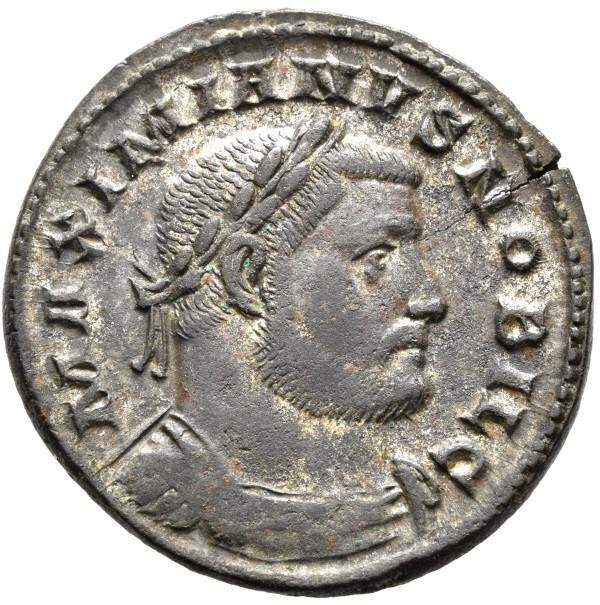
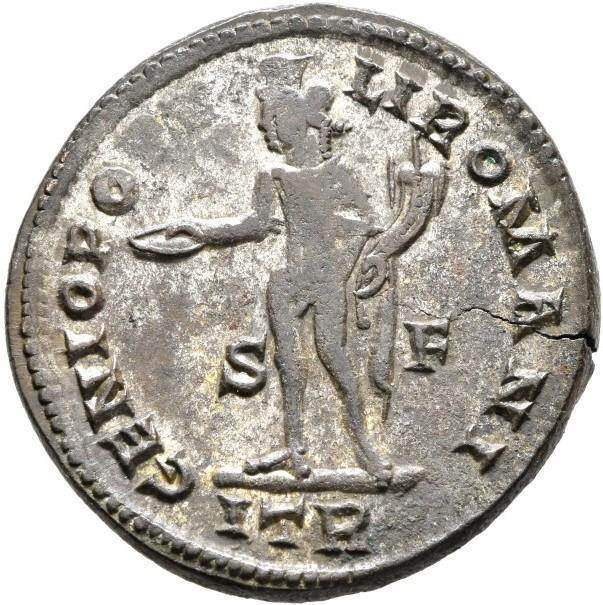
The Galerius “Genius of Rome” Follis (RIC VI Treveri 158b) is a heavy, bronze testament to the “Rule of Four”—the Tetrarchy—that saved the Roman Empire from total collapse. Struck around AD 298–299, this coin represents the raw, administrative power of a soldier-emperor who rose from a humble shepherd to become the most powerful man in the East.
At Numiscurio, we often say that a coin’s “soul” is found in its journey; to hold a piece from the Rauceby Hoard is to touch a literal buried treasure that lay undisturbed in the soil of Lincolnshire for over 1,700 years.
1. The Historical Context: The Iron Caesar
Galerius was the “muscle” of the Tetrarchy. While Diocletian handled the grand strategy, Galerius was the fierce general who crushed the Persians and solidified the frontiers. This follis was minted at Treveri (modern Trier, Germany), the imperial capital of the North and the primary military hub for the defense of the Rhine.
The most electrifying aspect of this specific coin is its provenance. Found in July 2017 by metal detectorists in Lincolnshire, the Rauceby Hoard consisted of over 3,000 copper-alloy coins buried in a ceramic vessel. It is one of the largest hoards ever found in Britain. The flan crack on this specimen is a “battle scar” of the minting process; the immense pressure of the heavy hammer-strike occasionally split the bronze blank, giving each coin a unique, rugged character that survived centuries in the English earth.
2. The Reverse: The Spirit of the People
The reverse features the Genius of the Roman People, standing front, head left, holding a patera (sacrificial bowl) and a cornucopia.
- The National Spirit: The Genius was the protective spirit of the entire Roman collective. In an age where the Empire was divided into four administrative zones, this imagery was the “glue” that reminded every citizen—from Britain to Egypt—that they were part of one indivisible Roman identity.
- The Patera and Cornucopia: The bowl represents religious duty (piety), while the horn of plenty represents the material wealth and abundance that the Tetrarchy promised to restore after decades of civil war.
- The Legend: GENIO POPVLI ROMANI. This was the universal slogan of the era, found on millions of coins across the Mediterranean world.
3. The Obverse: The Names of Two Emperors
The obverse features the laureate and cuirassed bust of Galerius, facing right.
- The Name Confusion: New collectors are often confused by the legend MAXIMIANVS NOBIL C. While it says “Maximianus,” this is actually Galerius (whose full name was Gaius Galerius Valerius Maximianus). He shared a name with his senior co-emperor, Maximian. We distinguish them by the title NOBIL C (Nobilissimus Caesar), which identifies Galerius as the junior heir at the time this was struck.
- The Tetrarchic Style: Notice the “blocky” realism—the thick neck, the military haircut, and the intense, square-jawed gaze. It was a style designed to convey an image of indestructible, granite-like authority.
- The Legend: MAXIMIANVS NOBIL C.
4. Technical Details: The Treveri Workshop
- RIC VI Treveri 158b: Cataloged in the sixth volume of Roman Imperial Coinage, covering the reorganization of the Empire.
- The Mint: Struck in Treveri (look for the B or C in the field and TR in the exergue). The Trier mint was famous for its high-quality engraving and heavy, impressive flans.
- The Hoard Surface: Rauceby Hoard coins often possess a beautiful, stable “find patina.” Because they were buried in a pot, many have escaped the aggressive corrosion often found on single-find coins, allowing the fine details of the Genius’s muscles and the Emperor’s laurel wreath to remain remarkably sharp.
