
Gemini said
The Galerius “Harmony of the Military” Antoninianus (RIC VI 16) serves as a striking silver-washed window into the “New Order” of the late 3rd century. Struck around AD 295–296, this coin was minted during the infancy of the Tetrarchy—the “Rule of Four”—at a time when the Roman world was being radically reorganized by the iron will of Diocletian and his fierce Caesar, Galerius.
1. The Historical Context: The Shepherd of the East
Galerius was the “muscle” of the Tetrarchy. A rugged Illyrian who rose from a humble shepherd to become a Caesar, he was the man Diocletian trusted to hold the volatile Eastern frontier. This coin was minted at Heraclea (modern Marmara Ereğlisi, Turkey), a strategic city on the road to Byzantium that served as a vital bridge between the European and Asian halves of the Empire.
The light deposits on this specimen are a “fingerprint of time”—mineral signatures of the soil where the coin lay for centuries. They remind us that this piece of military pay survived the collapse of the Roman world, the rise of the Byzantines, and the shifting sands of the Ottoman era before returning to the light.
2. The Reverse: The Divine Hand-Off
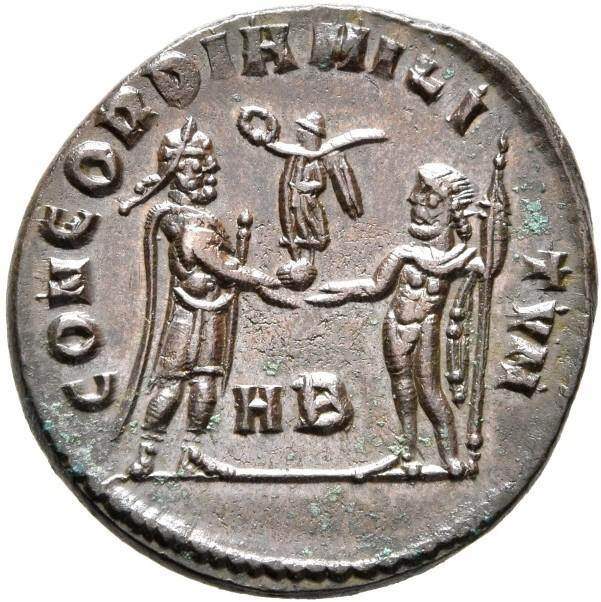
The reverse features a powerful scene of political theater: Galerius stands on the left, receiving Victory on a globe from Jupiter, who stands on the right.
- The Source of Power: By showing Jupiter handing Victory to Galerius, the mint was making a profound statement: the Caesar’s authority didn’t come from the Senate or the fickle whims of the mob, but directly from the Optimus Maximus (the Best and Greatest) of the gods.
- The Globe of Command: The globe represents the oikoumene—the civilized world. To hold the globe was to claim responsibility for the entire human race.
- The Legend: CONCORDIA MILITVM. This translates to “The Harmony of the Military.” In an age where the Empire had just emerged from 50 years of civil war, this was more than a title—it was a prayer and a command for the legions to remain unified.
3. The Obverse: The Names of a Caesar
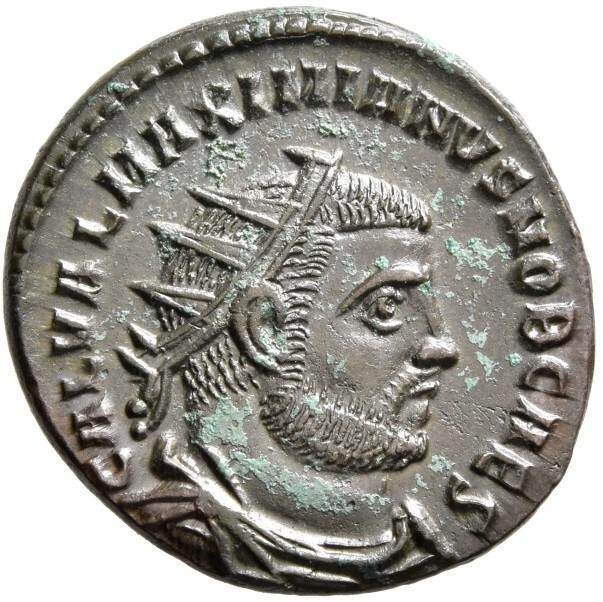
The obverse features the radiate, draped, and cuirassed bust of Galerius, facing right.
- The Shared Name: The legend GAL VAL MAXIMINVS NOB CAES can be tricky for collectors. Galerius’s full name included “Maximianus,” which he shared with his senior Augustus. We identify him as Galerius by the NOB CAES (Nobilissimus Caesar) title, which denotes his rank as the junior partner in the Tetrarchy at this time.
- The Radiate Crown: The “spikes” of the crown identify this as a radiate (the successor to the Antoninianus). While these coins were mostly copper by this point, they were issued with a thin silver wash to maintain the illusion of precious metal value.
- The Legend: GAL VAL MAXIMINVS NOB CAES.
4. Technical Details: The Heraclea Strike
- RIC VI 16: Cataloged in the fifth volume of Roman Imperial Coinage, representing the pre-reform and early reform period of the Tetrarchy.
- The Mint: Struck in Heraclea. You can identify this by the mint mark in the exergue (e.g., H, HB, HT, or HΔ). The Heraclea mint was known for its sharp, elegant engraving and its distinctively “clean” lettering compared to the busier mints of the West.
- The “Post-Reform” Vibe: This coin sits on the cusp of Diocletian’s great currency reform of AD 294. It retains the radiate crown of the old era but introduces the refined, standardized imagery that would define the next century of Roman numismatics.
