
The Farrukhan Silver Hemidrachm (Year 76 PYE) is a remarkable “time traveler” from the fog-shrouded forests of the Alborz Mountains. Struck around AD 727–728, this coin belongs to the Dabuyid Ispahbads—the fierce Persian governors who refused to let the Sasanian Empire die. While the rest of Persia had fallen to the Arab Conquest, the province of Tabaristan (modern-day Mazandaran, Iran) remained a stubborn bastion of Zoroastrian culture and Sasanian tradition for over a century.
1. The Historical Context: The Unconquerable Mountains
Farrukhan the Great was the most famous of the Dabuyid rulers. He was a master of guerrilla warfare, famously defeating the Umayyad armies by luring them into the narrow mountain passes of the Caspian coast.
To maintain his legitimacy, Farrukhan didn’t invent a new currency. Instead, he continued the Sasanian “Khusru” Style. These coins were struck on the Post-Yazdegard Era (PYE) calendar, which counted the years from the death of the last Sasanian King in AD 651. Your coin, dated Year 76, places it right in the heart of Farrukhan’s defiance, as he presided over a court that still spoke Pahlavi and practiced the ancient rites of the Fire Altar.
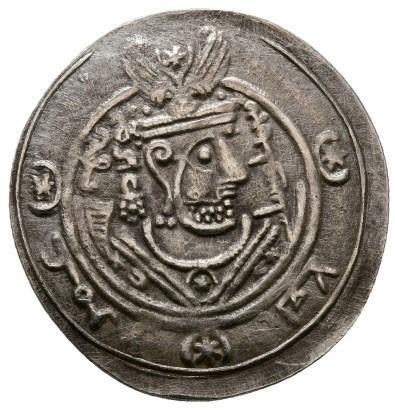
2. The Obverse: The Crown of the Khusrus
The obverse features a crowned bust, facing right, meticulously modeled after the great Sasanian King Khusru II.
- The Winged Crown: The wings represent the Verethragna (victory) and the divine Khvarenah (royal glory). Even though Farrukhan was an Ispahbad (General/Governor) and not a King of Kings, he used this crown to signal that the divine right to rule Persia had found sanctuary in the north.
- The Star and Crescent: These celestial symbols in the outer margin represent the king’s role as a cosmic protector, a tradition that would eventually influence Islamic and European heraldry.
- The Pahlavi Name: To the right of the face, the name Farrukhan is written in the Pahlavi script, a bold signature of local sovereignty.
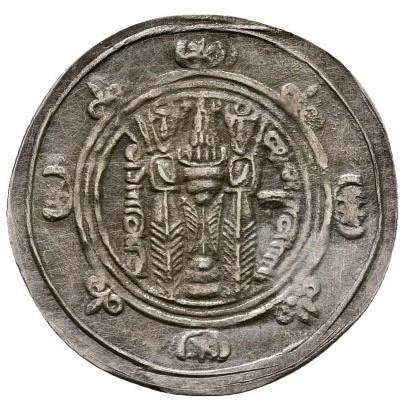
3. The Reverse: The Eternal Flame
The reverse features the classic Zoroastrian Fire Altar, flanked by two attendants (priests) standing facing.
- The Sacred Fire: At the top of the flame, you can see a star to the left and a crescent to the right. This represents the purity of the flame and its connection to the heavens.
- The Date (Year 76): On the left side, the Pahlavi numerals indicate the date. In the PYE system, Year 76 corresponds to approximately AD 727, just as the Umayyad Caliphate was reaching its maximum pressure on the mountain borders.
- The Mint Mark (TPWRSTAN): On the right is the mint signature for Tabaristan. This was a mobile or regional designation for the various workshops under the Ispahbad’s control.
- The Triple Border: The reverse is enclosed within three circles, a design feature intended to prevent “clipping” (shaving the edges for silver) and to frame the sacred imagery with dignity.
4. Technical Details: The “Half-Weight” Standard
- The Denomination: This is a Hemidrachm (Half-Drachm). While the Sasanians favored the large 4-gram Drachm, the Tabaristan rulers standardized this smaller 2-gram unit. It was the perfect size for trade across the Caspian Sea and the Silk Road.
- The Metal: High-purity silver. Despite being cut off from the central treasuries, the Ispahbads had access to rich silver mines in the Alborz mountains, allowing them to maintain a very high metallurgical standard.
- The Collector’s “Tell”: Look for the detail in the attendants’ robes and the individual pellets in the outer margin. Finding a specimen where the Pahlavi date (Year 76) is not “flatly struck” is a major find for any specialist of the Persian Resistance.
