
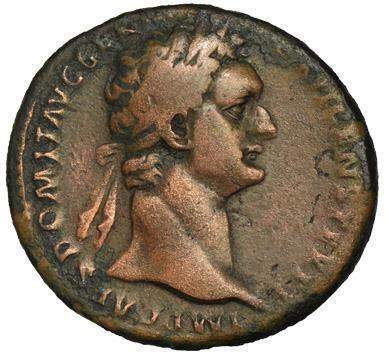
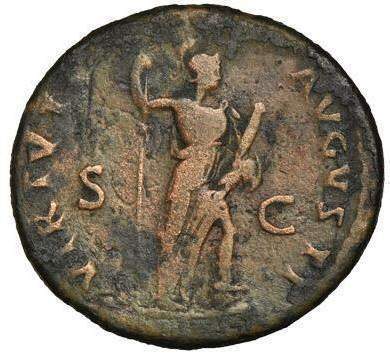
If you are looking for a coin that captures the “Iron Fist” of the Flavian dynasty, the Domitian Dupondius (RIC II.1 754) is a masterclass in imperial branding. Struck in AD 90–91, this golden-hued brass piece represents an Emperor who was obsessed with discipline, military glory, and his own divine status.
At Numiscurio, we often say that a coin’s “soul” is found in the story it tells about the man who commissioned it. Domitian was the last of the Flavians, and this coin shows him at the absolute peak of his autocratic power.
1. The Historical Context: The Master and God
By AD 90, Domitian had moved far beyond the “First Citizen” persona of Augustus. He demanded to be addressed as Dominus et Deus (Lord and God). While the Senate hated him, the army loved him because he raised their pay for the first time since the reign of Augustus.
This Dupondius (worth two Asses) was the currency of the legions and the Roman middle class. In the year this coin was struck, Domitian was celebrating his “victories” over the Chatti and the Dacians. He needed the Roman public to see him not just as a politician, but as the living embodiment of Roman Virtus (Courage/Military Virtue).
2. The Obverse: The Radiant Autocrat
The obverse features the radiate head of Domitian facing right.
- The Radiate Crown: This is the key “time stamp” for the denomination. The spiked crown represents the rays of the sun, a symbol that immediately distinguished the Dupondius from the laurel-headed As.
- The Legend:
IMP CAES DOMIT AVG GERM P M TR P X CENS P P.- GERM: This stands for Germanicus, a title Domitian took with immense pride after his campaigns across the Rhine.
- CENS P: Censor Perpetuus (Censor for Life). This was the title that gave him total control over Roman morality and the membership of the Senate.
3. The Reverse: Virtus—The Soul of the Soldier
The reverse depicts Virtus, the personification of bravery and military strength, standing right. She is depicted as a warrior goddess, resting her foot on a helmet, holding a spear and a parazonium (a ceremonial dagger).
- The Message: By placing Virtus on his coins, Domitian was telling the world that the Empire’s security rested solely on his shoulders. The foot on the helmet is a classic Roman “shorthand” for total victory and the pacification of enemies.
- The S C: As with all Roman base-metal coins, the large S C (Senatus Consulto) is present. In Domitian’s reign, this was purely symbolic—the Senate had no choice but to “decree” what the Emperor commanded.
4. Technical Details: The “Orichalcum” Glow
- Metal: Orichalcum (a golden-colored brass alloy of copper and zinc). When this coin was freshly minted, it would have looked almost like gold, a brilliant way to make a common coin feel “Imperial.”
- RIC II.1 754: This refers to the updated Second Edition of Roman Imperial Coinage, Volume II, Part 1.
- The Strike: Flavian bronze and brass are famous for their high-relief, “muscular” portrait styles. Domitian’s features—the slightly hooked nose and heavy jaw—are often rendered with incredible realism.
