

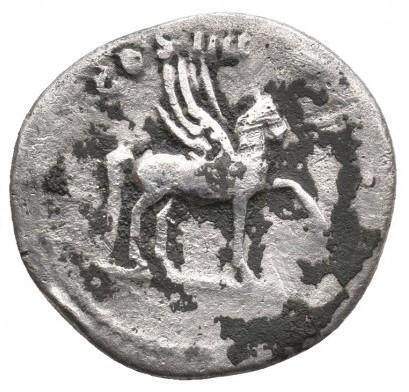
The Domitian “Pegasus” Denarius (RIC II.1 921) serves as a striking silver window into the early, ambitious years of the Flavian dynasty. Struck in AD 76, this coin was minted while Domitian was still a young Caesar under the shadow of his father, Vespasian, and his legendary brother, Titus. It is a piece of high-stakes dynastic branding, using the soaring imagery of Greek mythology to signal that the Flavians were not just rough soldiers, but divinely favored rulers of a new Roman era.
1. The Historical Context: The Prince in Waiting
By AD 76, the Flavian family had successfully stabilized the Empire after the chaotic “Year of the Four Emperors.” However, Vespasian faced a PR problem: unlike the previous Julio-Claudian dynasty (Nero, Augustus), the Flavians had no “divine” bloodline. They were commoners who had seized power by force.
To fix this, the Flavian mints began producing a series of “dynastic” coins. This denarius, struck in the name of the younger son, Domitian, uses Pegasus to link the family to the heroic traditions of the past. It was a visual argument for legitimacy: by controlling the “winged messenger” of the gods, the Flavians were claiming their rightful place among the stars.
2. The Reverse: The Celestial Messenger
The reverse features Pegasus, the immortal winged horse, standing right with its left foreleg raised and its wings gracefully curling over its back.
- The Symbol of Fame: In the ancient world, Pegasus was a symbol of Fama (Fame) and immortality. For Domitian, who was young and eager to prove his worth, this was a powerful statement of his rising status within the imperial household.
- The Raised Hoof: This specific “pawing” stance is a classic Hellenistic pose, suggesting Pegasus is about to take flight or has just struck the ground to create a sacred spring. It adds a sense of dynamic energy to the heavy silver flan.
- The Legend: COS IIII. This allows us to date the coin precisely to AD 76, marking Domitian’s fourth consulship—a role he held primarily as a ceremonial honor while his father and brother handled the heavy lifting of the state.
3. The Obverse: The Young Caesar
The obverse features the laureate head of Domitian, facing right.
- The Family Likeness: Notice the “Flavian” features—the slightly hooked nose and the strong jawline that he shared with Vespasian. However, at this early stage, his portrait lacks the heavy, “fleshy” look of his later years as Emperor. He is depicted as a lean, capable prince.
- The Son of Augustus: The legend CAESAR AVG F DOMITIANVS is crucial. The F stands for Filius (Son), explicitly identifying him as the “Son of the Augustus” (Vespasian). It is a coin about inheritance and the future of the throne.
- The Legend: CAESAR AVG F DOMITIANVS.
4. Technical Details: The Early Flavian Strike
- RIC II.1 921 (Vespasian): Though it bears Domitian’s name, it is cataloged under the reign of Vespasian in the Roman Imperial Coinage series.
- The Mint: Struck in Rome. The early Flavian denarii are known for their bold, high-relief portraits and their remarkably consistent silver quality as Vespasian worked to repair the economy Nero had wrecked.
- The Artistic Flair: The “curling wing” style of Pegasus on these issues is considered one of the most beautiful animal depictions in Roman numismatics. Finding a specimen where the individual feathers of the wings are not worn away is a high-priority target for collectors of the 12 Caesars.
