
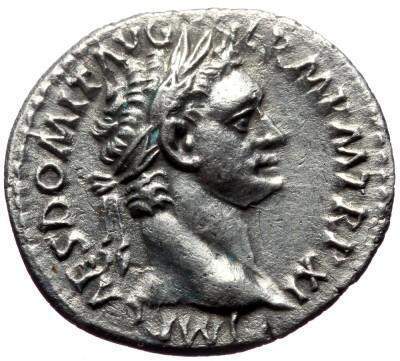
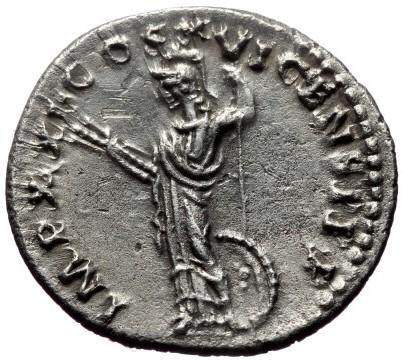
The Domitian “Thunderbolt Minerva” Denarius (RIC II.1 731) serves as a striking silver window into the obsessive, militaristic, and deeply religious mind of the last Flavian Emperor. Struck in AD 92, this coin was part of a relentless, decade-long campaign to reshape the Roman world in the image of his favorite goddess—Minerva—while Domitian himself was increasingly retreating into the fortress of his own paranoia.
1. The Historical Context: The Goddess and the Despot
By AD 92, Domitian had dispensed with the “first among equals” facade of his father Vespasian and brother Titus. He demanded to be addressed as Dominus et Deus (Lord and God). Central to this divine persona was his fanatical devotion to Minerva. He didn’t just sacrifice to her; he claimed she was his personal protector and even his mother in a mystical sense.
This denarius was minted during the height of his “Germanic” triumphs. While the Senate hated him for his autocracy, the legions loved him because he raised their pay and personally led campaigns on the Rhine and Danube. This coin was the “paycheck of the loyalist,” carrying the image of a warrior goddess to the men who kept Domitian on the throne.
2. The Reverse: Minerva the Thunder-Wielder
The reverse features Minerva, the goddess of wisdom and war, standing left, holding a thunderbolt and a spear, with a shield resting at her side.
- The Borrowed Lightning: This is one of the most aggressive depictions of Minerva in the Roman series. By showing her with a thunderbolt—the traditional weapon of Jupiter—Domitian was signaling that his patroness had inherited the supreme power of the heavens to protect his reign.
- The Armed Peace: Minerva stands ready, her spear and shield indicating that while Rome was currently “at peace,” it was a peace maintained by overwhelming force.
- The Legend: IMP XXI COS XVI CENS P P P. This allows us to date the coin precisely. It marks his 16th consulship and his unprecedented title of Censor Perpetuus (Censor for Life), which gave him total control over Roman morality and the Senate’s membership.
3. The Obverse: The Last Flavian
The obverse features the laureate head of Domitian, facing right.
- The High Imperial Portrait: Domitian’s portraits are some of the most technically accomplished in the Roman series. Notice the high forehead, the slightly hooked nose, and the strong, determined jawline. Unlike the earthy, “common man” look of his father Vespasian, Domitian looks every bit the aristocrat.
- The Germanic Title: The legend includes GERM (Germanicus), the title he took after his campaigns against the Chatti. It was his proudest achievement, even though his detractors in Rome whispered that his “triumphs” were staged.
- The Legend: IMP CAES DOMIT AVG GERM P M TR P XI.
4. Technical Details: The Flavian Silver Purity
- RIC II.1 731: Cataloged in the updated second volume of Roman Imperial Coinage.
- The Mint: Struck in Rome. Domitian’s reign saw a significant increase in the silver purity of the denarius—he actually tried to restore the currency to the standards of Augustus. Because of this, his coins often have a brilliant, high-quality luster compared to the debased silver of the later 2nd century.
- The Condition: Finding a Domitian denarius with a sharp “thunderbolt” in Minerva’s hand is a true prize. Because these were high-purity coins, they were often hoarded, meaning we occasionally find specimens in stunning, “near-mint” condition today.
