
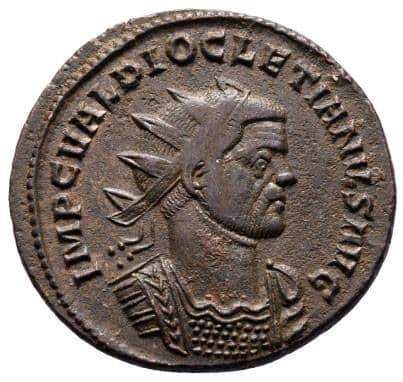
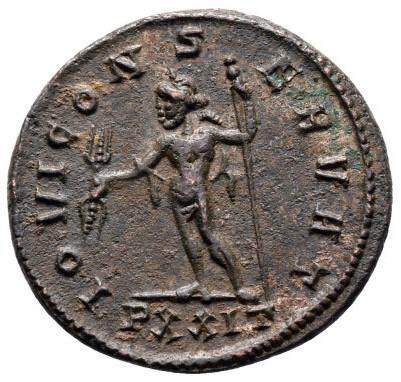
The Diocletian “Jupiter the Conservator” Antoninianus (RIC V 222) is a heavy-hitting piece of political propaganda struck between AD 284–285. Minted at Ticinum (modern Pavia, Italy), this coin represents the precise moment the “Crisis of the Third Century” ended and the iron-fisted stability of the Tetrarchy began. It is the visual manifesto of a man who didn’t just want to be an Emperor—he wanted to be the earthly shadow of the King of the Gods.
At Numiscurio, we often say that a coin’s “soul” is found in its divine alignment; by choosing Jupiter as his personal protector, Diocletian was telling the world that the era of military coups was over, replaced by a mandate from the heavens.
1. The Historical Context: The Architect of the New Empire
When Diocletian seized power in AD 284, the Roman Empire was a fractured, bankrupt mess. His solution was radical: he realized the Empire was too big for one man and eventually divided it among four rulers. But before he shared power, he had to prove he was the legitimate choice of the gods.
This coin was struck at Ticinum, a vital strategic mint near the Alpine passes. By invoking IOVI CONSERVAT (Jupiter the Conservator), Diocletian was reaching back to the most traditional Roman roots. He was the “Jovian” Emperor, a ruler whose authority was as immovable as Jupiter’s throne on Mount Olympus. This wasn’t just religion; it was a warning to any would-be usurpers: to rebel against Diocletian was to declare war on the King of the Gods.
2. The Reverse: The Thunderbolt of Law
The reverse features Jupiter, the supreme deity of the Roman pantheon, standing left. He holds a thunderbolt in his right hand and a long scepter in his left. Often, his faithful eagle—the messenger of divine will—sits at his feet.
- The Thunderbolt of Justice: Unlike later coins where Jupiter holds a globe, the thunderbolt emphasizes his role as the “Preserver” (Conservator) who strikes down the enemies of the state. It represents the “active” protection of the Roman world.
- The Scepter of Sovereignty: The long scepter symbolizes the eternal, unchanging law of the cosmos.
- The Legend: IOVI CONSERVAT. A shortened form of Iovi Conservatori, a dedication to Jupiter the Preserver.
3. The Obverse: The Pannonian Strongman
The obverse features the radiate and cuirassed bust of Diocletian, facing right.
- The Soldier’s Profile: This early portrait still captures the “Barracks Emperor” style—a rugged jawline, a short military haircut, and a thick, powerful neck. Diocletian was a career soldier from the Balkans, and this portrait screams “discipline.”
- The Full Imperial Titles: The legend IMP C C VAL DIOCLETIANVS P F AVG (Imperator Caesar Caius Valerius Diocletianus Pius Felix Augustus) lays out his full formal name, anchoring his legitimacy in the deepest traditions of the Roman state.
- The Legend: IMP C C VAL DIOCLETIANVS P F AVG.
4. Technical Details: The Ticinum Workshop
- RIC V 222: Cataloged in the fifth volume of Roman Imperial Coinage, representing the final evolution of the Antoninianus before Diocletian’s massive currency reform.
- The Mint: Struck in Ticinum. The Ticinum mint was famous for its sharp, clean engraving and its heavy, substantial flans.
- The “XXI” Standard: Look in the exergue for the XXI mark. This was a guarantee of value (20 parts copper to 1 part silver). These coins were originally issued with a bright silver wash to make them look like pure silver. Finding a specimen from Ticinum where this original “bright” silvering still catches the light in the folds of Jupiter’s cloak is a major highlight for any collector of the late 3rd century.
