

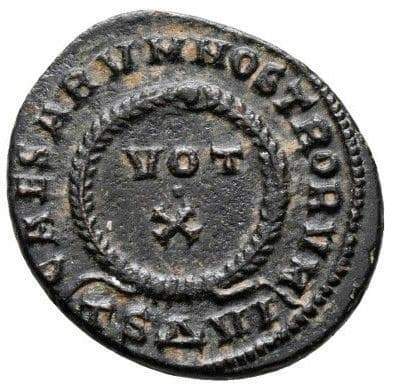
The Crispus “Vows of the Decade” Follis (RIC VII Thessalonica 125) is a poignant and sharply struck bronze issued between AD 320–324. Struck at the strategic Balkan mint of Thessalonica, this coin represents the zenith of a young prince’s career—a hero of the Rhine and the designated heir to the Roman world, whose life would soon end in one of the most mysterious tragedies of the Constantinian dynasty.
1. The Historical Context: The Rising Sun of the West
Crispus was the eldest son of Constantine the Great, born of his first wife, Minervina. By the time this coin was struck, Crispus was the “Golden Boy” of the Empire. He was a brilliant naval commander who had crushed the Frankish tribes and would soon play the decisive role in defeating Licinius to unite the Empire.
The VOT X (Vota Decennalia) legend refers to the “Vows” the Caesar took. In Roman tradition, an emperor would make a sacred pact with the gods: if the gods granted him ten years of successful rule, he would perform great sacrifices and renew those vows for the next decade. For Crispus, these ten years had been a triumph of military and administrative skill. He was the Nobilissimus Caesar—the most noble heir.
2. The Reverse: The Wreath of Victory
The reverse is elegantly simple: the inscription VOT / X (Vows for Ten Years) enclosed within a heavy laurel wreath. Around the edge runs the legend CAESARVM NOSTRORVM (Of Our Caesars).
- The Laurel Wreath: A symbol of victory and peace since the days of Augustus. By placing the vows inside the wreath, the mint was signaling that the first decade of the Caesars’ rule had brought stability back to the Roman world.
- The “Our Caesars” Legend: This was a collective plural. It referred to the team of junior emperors—Crispus and his younger brothers—who stood as the pillars supporting their father’s throne.
- The Symbol of Continuity: These coins were often distributed as “donatives” (bonuses) to the legions and bureaucracy during the anniversary celebrations.
3. The Obverse: The Left-Facing Commander
The obverse features the laureate, draped, and cuirassed bust of Crispus, facing left.
- The Leftward Gaze: In Constantinian numismatics, a left-facing bust is almost always more desirable for collectors. It was often used for the Emperor’s sons to distinguish them from the right-facing portraits of their father, giving the coin a more dynamic, “heroic” profile.
- The Military Attire: Crispus is shown cuirassed (armored), emphasizing his role as a frontline general. Despite his youth, he was a battle-hardened veteran of the northern frontiers.
- The Legend: FL IVL CRISPVS NOB CAES (Flavius Iulius Crispus Nobilissimus Caesar).
4. Technical Details: The Thessalonica Strike
- RIC VII Thessalonica 125: Cataloged in the seventh volume of Roman Imperial Coinage.
- The Mint Mark: Look in the exergue (the bottom) for TSA, TSBVI, or similar. The TS stands for Thessalonica, and the Greek letter (A, B, Γ, Δ, or E) indicates which of the five specific workshops struck the coin.
- The Condition: The Thessalonica mint was famous for its high-quality bronze and deep, dark patinas. Because these coins were struck in massive quantities for the decennalia, they often survive in incredible condition. Finding a specimen where the individual berries in the laurel wreath are still visible is the mark of a well-preserved Balkan strike.
