
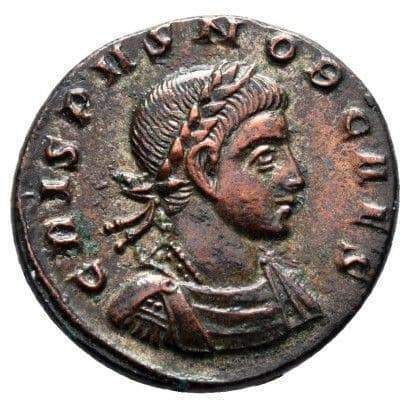
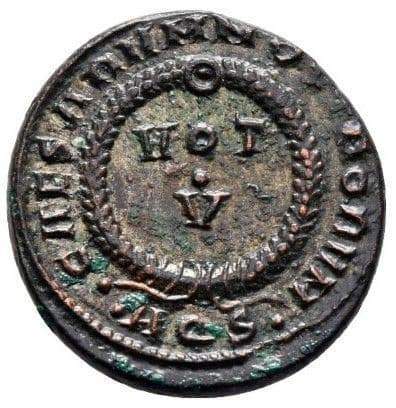
The Crispus “Vows of Ten Years” Follis (RIC VII Aquileia 108) serves as a poignant bronze window into the meteoric rise and tragic fall of Constantine the Great’s eldest son. Struck around AD 321–322, this piece was part of a celebratory empire-wide issue marking the tenth anniversary (Decennalia) of Crispus being raised to the rank of Caesar—a moment when he was the undisputed heir to the Roman world.
1. The Historical Context: The Shining Star of the West
Crispus was the golden boy of the Constantinian dynasty. A brilliant naval commander and a fierce general, he had crushed the Franks on the Rhine and would later play the decisive role in defeating Licinius’s fleet at the Hellespont. When this coin was minted in Aquileia, Crispus was at the height of his popularity, beloved by the legions and groomed by his father to be the next Augustus.
The “VOT X” (Vota Decennalia) on the reverse represents the solemn religious vows the Caesar took to serve the state for ten years, and the public’s prayers for ten more. It was a “jubilee” coin, intended to spread a sense of dynastic stability. Tragically, just four years after these vows were celebrated, Constantine would have his son executed under mysterious circumstances—wiping the “Shining Star” from history in one of Rome’s darkest family dramas.
2. The Reverse: The Laurel Wreath of Victory
The reverse features the inscription VOT / X (Vota Decennalia) centered within a thick, ornate laurel wreath.
- The Sacred Vows: The “VOT X” refers to the Vota Soluta (vows fulfilled for the first ten years) and Vota Suscepta (vows taken for the next ten). It was a contract between the ruler, the people, and the gods.
- The Symbol of Triumph: The laurel wreath was the ancient symbol of Apollo and military victory. By encircling the vows in laurel, the mint was reminding the public that the peace they enjoyed was bought by Crispus’s victories on the frontier.
- The Legend: CAESARVM NOSTRORVM. This translates to “Of Our Caesars,” a collective nod to the junior rulers of the Constantinian house.
3. The Obverse: The Princely Portrait
The obverse features the laureate head of Crispus, facing right.
- The Youthful Caesar: Notice the smooth, clean-shaven features. Crispus is depicted as a young, energetic leader. Unlike the rugged, “blocky” portraits of the earlier Tetrarchy, the Constantinian style returned to a more classical, idealized beauty.
- The Imperial Title: The legend identifies him as IVL CRIS-PVS NOB C (Julius Crispus Nobilissimus Caesar). The title “Most Noble Caesar” was the highest rank below Augustus himself.
- The Legend: IVL CRIS-PVS NOB C.
4. Technical Details: The Aquileia Craft
- RIC VII Aquileia 108: Cataloged in the seventh volume of Roman Imperial Coinage.
- The Mint: Struck in Aquileia (Northern Italy). Aquileia was a vital strategic hub at the head of the Adriatic, often serving as the primary mint for the defense of the Italian peninsula. You can identify it by the mint mark in the exergue (e.g., AQT, AQS, or AQT-star).
- The Condition: These “Votive” issues were struck in massive quantities, but finding a specimen from Aquileia with a sharp, “mirror-like” strike and a deep chocolate-brown patina is a true collector’s prize.
