
The Crispus “Eternal Rome” Follis (RIC VII Rome 152) is a spectacular and rare bronze issue struck around AD 320. This coin is a masterclass in Constantinian propaganda, combining the “heroic” imagery of a young prince with the most sacred symbol of Roman identity: the goddess Roma herself. At Numiscurio, we often highlight that while many 4th-century coins feel “standardized,” this specific issue from the Rome mint possesses a sculptural energy that harkens back to the high artistry of the earlier Empire.
To hold this coin is to see Crispus at the absolute height of his prestige—the “rising sun” of the West who would soon become a tragic footnote in history.
1. The Historical Context: The Hero of the Rhine
Crispus, the eldest son of Constantine the Great, was the designated heir to the Roman world. By AD 320, he had already proven himself a brilliant general, securing the Rhine frontier against the Franks and Alamanni.
This coin was minted during a period of relative peace between Constantine and his rival Licinius. The legend ROMAE AETERNAE (Eternal Rome) was a powerful political statement. By issuing these coins in the city of Rome itself, Constantine was reassuring the ancient capital—which was increasingly feeling sidelined by the rise of the East—that it remained the spiritual and eternal heart of the Empire, guarded by his heroic son.
2. The Reverse: Roma and the Vows of Victory
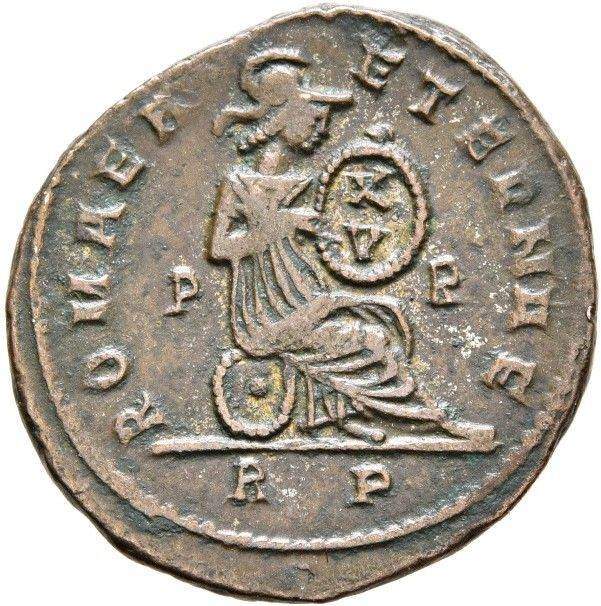
The reverse features Roma, the personification of the city, seated right. She is busy inscribing a shield set on her knee with the numerals X/V (Vota Decennalia / Vicennalia).
- The Sacred Record: Roma is literally “writing history.” The X/V refers to the Vows—the first ten years of successful rule completed, and the promise for fifteen. It was a religious contract with the gods to ensure the continued safety of the state.
- The Shield and Armor: Notice the shield at Roma’s side. This isn’t the Roma of peace, but the Roma of the legions. She is the armed protector of the Constantinian dynasty.
- The Legend: ROMAE AETERNAE. This was a “comfort” slogan for a city that was no longer the primary residence of the Emperors but still demanded its due respect.
3. The Obverse: The “Heroic” Rear-View
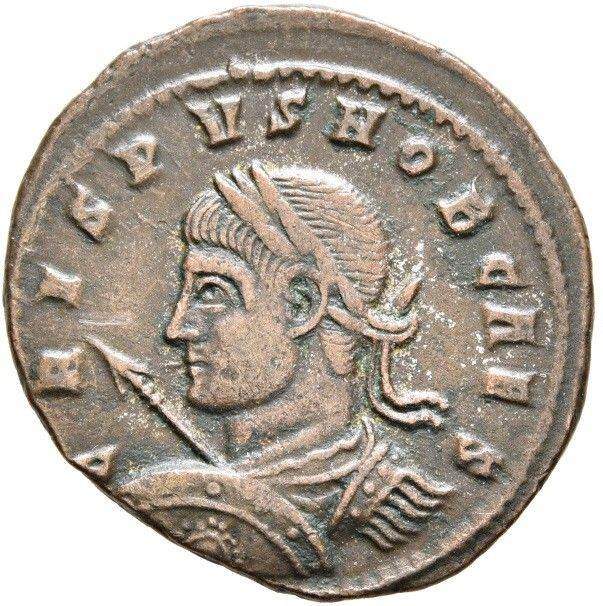
The obverse is the true highlight for collectors: the laureate, draped, and cuirassed bust of Crispus, facing left and seen from behind.
- The Warrior’s Perspective: This “rear-view” (heroic) bust is highly sought after. It emphasizes the spear held in his right hand and the shield on his left arm. It portrays Crispus not as a distant bureaucrat, but as a soldier in the thick of the action, ready to turn and face any threat to the Empire.
- The Shield Detail: On well-preserved specimens, the shield on his arm often features intricate patterns or even a small Adlocutio scene (the Emperor addressing his troops), showing the incredible skill of the engravers at the Rome mint.
- The Legend: CRISPVS NOB CAES (Crispus Nobilissimus Caesar).
4. Technical Details: The Rome Mint “R P”
- RIC VII Rome 152: Cataloged in the seventh volume of Roman Imperial Coinage.
- The Mint Mark: Look in the exergue (the bottom) for R P. The R stands for Roma, and the P (Prima) identifies the 1st Workshop of the city. The letters P — R in the fields are additional control marks.
- The Patina: Rome mint bronzes of this era are famous for their deep, “river” green or dark “chocolate” patinas. Finding a specimen where the individual scales of the cuirass or the letters on Roma’s shield are still legible is a premier find for any specialist of the 4th-century “Good Princes.”
