
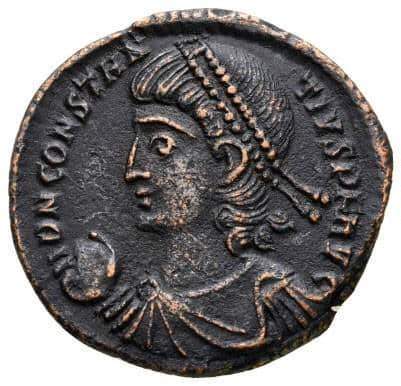
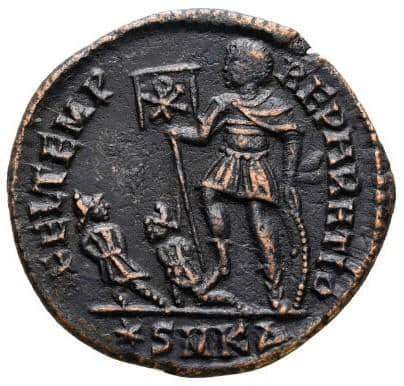
The Constantius II “The Triumphant Emperor” Follis (RIC VIII Cyzicus 84) is a powerful piece of mid-4th-century propaganda struck between AD 348–351. This coin was part of the massive FEL TEMP REPARATIO reform, a series launched to celebrate the 1,100th anniversary of Rome. While other coins in this series show scenes of migration or fallen enemies, the “Two Captives” type is a blunt statement of absolute military dominance.
At Numiscurio, we often say that a coin’s “soul” is found in its symbolism; here, the transition from the pagan Roman world to the Christian Empire is literally held in the Emperor’s hand.
1. The Historical Context: The Iron Will of the East
Constantius II, the middle son of Constantine the Great, was a ruler defined by survival. While his brothers fell to assassins and civil wars, Constantius held the Eastern Empire against the relentless Sassanid Persians. This coin was struck in Cyzicus (on the Sea of Marmara), a vital strategic mint that supplied the legions guarding the gateway between Europe and Asia.
The FEL TEMP REPARATIO (The Restoration of Happy Times) legend was an optimistic slogan during a dark century. By placing the Emperor above kneeling captives, the mint was telling the Roman public that “Happy Times” weren’t just a gift—they were a peace enforced by the sword.
2. The Reverse: The Labarum and the Vanquished
The reverse features Constantius II in full military attire, standing tall and holding the Labarum (a military standard emblazoned with the Chi-Rho, the symbol of Christ). To his left, two captives kneel in submission.
- The Christian Standard: The Labarum was the sacred banner of the Constantinian dynasty. Its presence here marks the definitive shift toward Christianity; the Emperor isn’t just a general, he is a protector of the faith.
- The Captives: Notice the scale—the Emperor is depicted as a giant compared to the kneeling figures. This “hieratic scale” was used to emphasize the semi-divine status of the Augustus. The two captives likely represent the Germanic or Persian threats that Constantius worked tirelessly to suppress.
- The Legend: FEL TEMP REPARATIO.
3. The Obverse: The Sovereign of the Globe
The obverse features the pearl-diademed, draped, and cuirassed bust of Constantius II, facing left.
- The Left-Facing Portrait: In 4th-century numismatics, a left-facing bust is often a sign of a special or celebratory issue. It creates a more regal, contemplative profile than the standard right-facing types.
- The Globe of the World: Constantius holds a globe in his right hand. This is the ultimate symbol of Cosmocrator (Ruler of the Universe). In an age of crumbling borders, the globe was a reassuring promise that the Emperor still held the world in his grasp.
- The Legend: D N CONSTANTIVS P F AVG (Dominus Noster Constantius Pius Felix Augustus).
4. Technical Details: The Cyzicus Workshop
- RIC VIII Cyzicus 84: Cataloged in the eighth volume of Roman Imperial Coinage.
- The Mint Mark: Look in the exergue for *SMKΓ. The SM stands for Sacra Moneta (Sacred Money), K for Cyzicus, and the Greek letter Γ (Gamma) identifies the 3rd Workshop of the mint. The star (*) is a series mark used for internal tracking.
- The Strike: Cyzicus was known for its sharp, clean engraving. On well-preserved specimens, you can see the individual “scales” of the Emperor’s armor and the desperate expressions on the faces of the small captives.
