
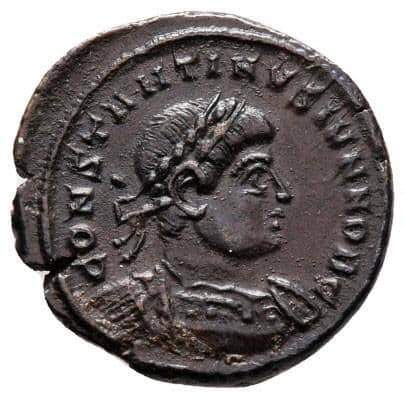
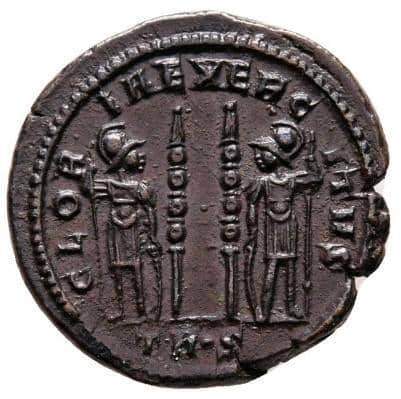
The Constantine II “Glory of the Army” Follis (RIC VII 520 Treveri) is a crisp, bronze window into the final decade of the Constantinian dynasty. Struck between AD 330–335 in the imperial city of Treveri (modern Trier, Germany), this coin represents the shift from the individual “Hero-Emperor” to the collective power of the Roman military machine.
1. The Historical Context: The Heir in the North
Constantine II was the eldest son of Constantine the Great, and by the time this coin was struck, he had been serving as a “Caesar” (junior emperor) for over a decade. He was headquartered in Treveri, the primary military capital for the defense of Gaul and Britain.
The GLORIA EXERCITVS (Glory of the Army) series was a massive, Empire-wide propaganda campaign. Following the dedication of the new capital at Constantinople in AD 330, the Emperor needed to reassure the legions that they—and not just the new city—were the true foundation of Roman security. This was the “paycheck of the frontier,” distributed to the soldiers who kept the Germanic tribes at bay.
2. The Reverse: The Pillars of the Empire
The reverse features two soldiers standing face-to-face, each holding a spear and leaning on a shield. Between them stand two military standards (signa).
- The Two Standards: In the early 330s, this type featured two standards. Later, after AD 335, it was reduced to a single standard. The “Two Standard” variety is generally more aesthetically balanced and shows the peak of the Treveri mint’s engraving skill.
- The Banner of Loyalty: The standards often feature small dots or “O” marks, representing the medals (phalerae) and honors won by the units.
- The Legend: GLORIA EXERCITVS. This was a blunt, effective slogan. It tied the soldier’s personal pride directly to the glory of the Imperial house.
3. The Obverse: The Young Caesar
The obverse features the laureate and cuirassed bust of Constantine II, facing right.
- The Junior Title: The legend CONSTANTINVS IVN NOB C stands for Constantinus Iunior Nobilissimus Caesar. It identifies him as the “Most Noble Junior Caesar,” distinguishing him from his famous father.
- The Military Portrait: Unlike the “heavenward-gazing” portraits of Constantine the Great, his sons were often depicted in a more traditional, military style—cuirassed (armored) and ready for the field.
- The Treveri Style: The Trier mint was legendary for its neat, compact portraits and exceptionally clear lettering. Even on these smaller bronzes, the individual laurel leaves in the crown are often remarkably distinct.
4. Technical Details: The Trier Workshop
- RIC VII 520 Treveri: Cataloged in the seventh volume of Roman Imperial Coinage, which covers the Christian Empire’s reorganization.
- The Mint Mark: Look in the exergue (the bottom) for marks like TRP or TRS. The TR stands for Treveri, while the P (Prima) or S (Secunda) identifies which specific workshop struck the coin.
- The Silver Wash: When these coins left the mint, they were coated in a thin, bright silver wash. While most have lost this over the centuries, finding a specimen with a dark, chocolate-brown patina or “silvering” in the deep recesses of the soldiers’ armor is the mark of a well-preserved late Roman bronze.
