
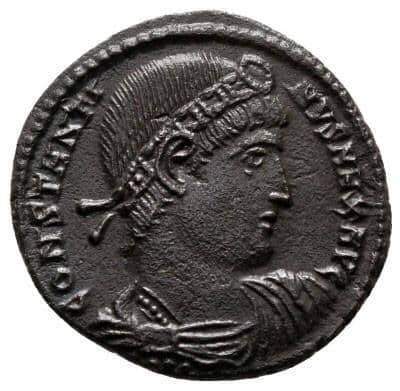
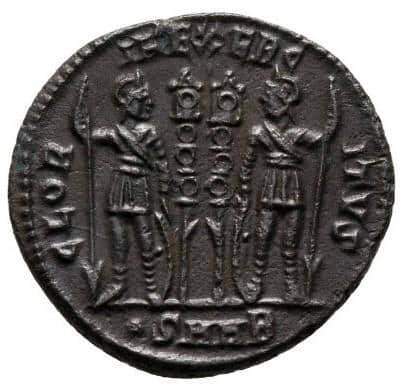
The Constantine the Great “Glory of the Army” Follis (RIC VII Heraclea 116) is a poignant bronze from the final years of the first Christian Emperor. Struck around AD 336–337 in the Thracian city of Heraclea (modern Marmara Ereğlisi, Turkey), this coin represents the military “Old Guard” of a dying Emperor who had fundamentally reshaped the world.
1. The Historical Context: The Sunset of a Titan
By the time this coin was struck, Constantine had ruled for three decades, moved the capital to Constantinople, and legalized Christianity. However, as his health began to fail, his focus shifted back to the men who had put him on the throne: the soldiers.
This coin was issued just before Constantine’s death in AD 337. Heraclea, located near the new capital, was a vital strategic mint. The GLORIA EXERCITVS (Glory of the Army) series was a massive propaganda effort to ensure the transition of power to his three sons would be supported by the military. It was a visual “thank you” to the troops who guarded the frontiers against the Goths and Persians.
2. The Reverse: One Standard, Two Soldiers
The reverse features two soldiers standing face-to-face, each holding a spear and leaning on a shield. Between them stands one military standard (signum).
- The Single Standard: Early versions of this coin (AD 330, 335) featured two standards. By AD 336, the design was simplified to a single standard. This often allowed for more detail in the banner (vexillum), which sometimes featured a small dot or a symbol representing the specific honors of a legion.
- The Symmetrical Guard: The soldiers are “draped and cuirassed,” showing the evolution of 4th-century Roman armor. They look at one another as if standing watch over the Empire itself.
- The Legend: GLOR, IA EXERC, ITVS. The legend is broken by the soldiers’ spears, a common stylistic choice in the late Roman period to emphasize the verticality of the weapons.
3. The Obverse: The Rosette-Diademed Augustus
The obverse features the bust of Constantine I, facing right.
- The Rosette Diadem: Unlike the earlier “laurels” of the soldier-emperors, Constantine here wears a rosette-diadem—a headband adorned with jewels. This was a move away from the military crown toward a more “Oriental” and “Divinely-Sanctioned” style of kingship.
- The “Max” Title: The legend CONSTANTINVS MAX AVG (Constantinus Maximus Augustus) reminds the user that he was not just an emperor, but “The Great.”
- The Heraclea Style: The Heraclea mint was known for a very specific, almost “sculptural” treatment of the Emperor’s face, often giving Constantine a slightly more mature and somber expression than the mints in Gaul or Rome.
4. Technical Details: The Heraclea Workshop
- RIC VII Heraclea 116: Cataloged in the seventh volume of Roman Imperial Coinage, the primary reference for the era of Constantine.
- The Mint Mark: Look in the exergue (the bottom) for the mark SMH. The SM stands for Sacra Moneta (Sacred Money), and the H for Heraclea. A Greek letter like A, B, or Γ after the H identifies which specific workshop struck your coin.
- The Condition: These bronzes were often struck on small, compact flans. Finding a specimen where the individual “phalerae” (medals) on the central standard are still distinct is a sign of a very sharp strike and a highlight for any 4th-century collection.
