
The Constans “Hut” Follis (RIC VIII Rome 140) is one of the most evocative and debated pieces of late Roman propaganda. Struck around AD 348–350, this coin was part of a massive currency reform launched to coincide with the 1,100th anniversary of the founding of Rome. It represents a shift from the purely militaristic “slaughtering enemies” coins to a more complex, narrative-driven message of imperial renewal and “civilizing” power.
At Numiscurio, we often say that a coin’s “soul” is found in its storytelling; while other coins show the army in battle, this “Hut” type shows the Empire as a guardian, moving people from the wilderness into the light of Roman order.
1. The Historical Context: The 1,100th Birthday
Constans, the youngest son of Constantine the Great, ruled the Western Empire during a time of relative stability but increasing pressure on the borders. To mark the spectacular milestone of Rome’s 1,100th birthday, the brothers Constans and Constantius II issued the FEL TEMP REPARATIO series.
The phrase translates to “The Restoration of Happy Times.” This specific “Hut” type is widely believed by historians to symbolize the Roman policy of Translatio—the forced or invited resettlement of barbarian tribes (possibly Germans or Sarmatians) from their primitive dwellings beyond the frontier into Roman territory to serve as farmers and future soldiers.
2. The Reverse: The Soldier and the “Wild”
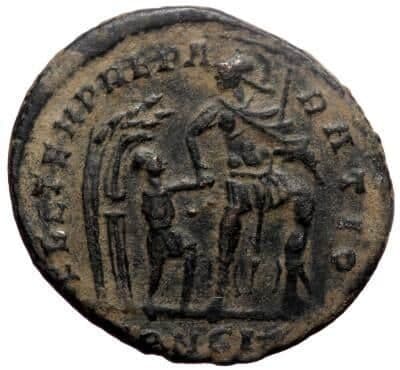
The reverse features a soldier in full military gear, advancing right but looking back left, as he leads a small, bare-headed figure by the hand from a thatched hut beneath a tree.
- The Gentle Guide: Notice the soldier is not brandishing his spear at the figure; he is guiding them. This was the “soft power” of the 4th century—the idea that the Roman military wasn’t just a killing machine, but a force that brought “backward” peoples into the prosperity of the Empire.
- The Symbolism of the Tree: The tree represents the uncultivated world—the forests of Germania or the wilds of the North. By leading the figure away from the tree and the hut, the soldier is bringing them into the cultivated Roman world.
- The Legend: FEL TEMP REPARATIO. This slogan became so iconic it remained the standard for Roman bronze coinage for nearly a decade.
3. The Obverse: The Sovereign of the West
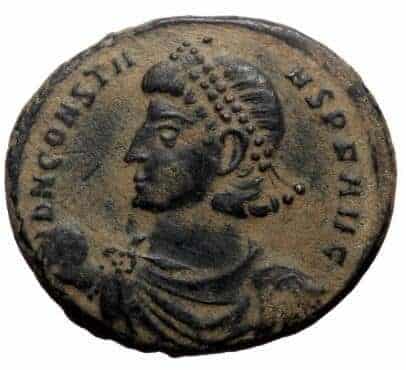
The obverse features the pearl-diademed, draped, and cuirassed bust of Constans, facing left.
- The Left-Facing Profile: In the 4th century, a portrait facing left was often a deliberate choice for special celebratory issues. It gives the coin a distinctive, regal silhouette that stands out in a tray of right-facing portraits.
- The Globe of Command: Constans is shown holding a globe in his right hand. This is the ultimate symbol of Cosmocrator—the ruler of the world. It signaled that even though the Empire was geographically divided among brothers, their authority was universal and absolute.
- The Legend: D N CONSTA-NS P F AVG (Dominus Noster Constans Pius Felix Augustus).
4. Technical Details: The Rome Mint Strike
- RIC VIII Rome 140: Cataloged in the eighth volume of Roman Imperial Coinage.
- The Mint: Struck in Rome. Look in the exergue for the mark RQ, RT, or RP (Roma Quarta, Tertia, or Prima). The Rome mint during this period produced very consistent, round flans with a high level of detail in the “thatch” of the hut.
- The Silvering: These “Ae2” centenionales were originally issued with a thin, bright silver wash. Over 1,600 years, this often wears away to reveal a rich, dark chocolate-brown patina. Finding a specimen where the individual fingers of the soldier leading the child are still distinct is a sign of a very early die strike.
