
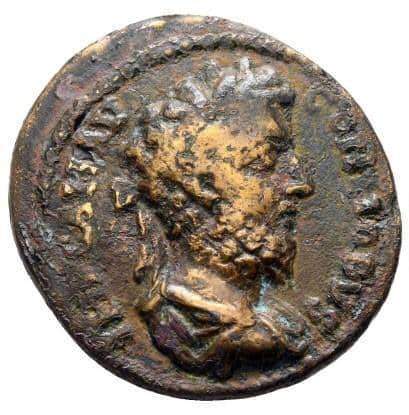
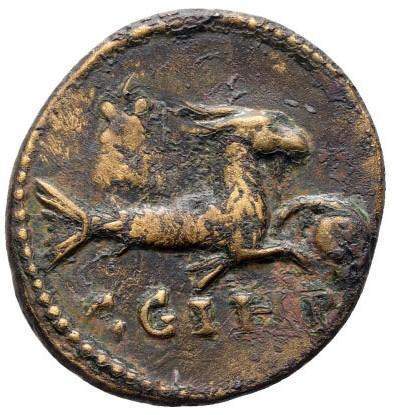
The Commodus “Capricorn of the East” Bronze (RPC IV 3153) is a fascinating provincial issue that blends the raw power of a Roman Emperor with the deep, astrological symbolism of the Augustan Age. Struck between AD 180–192 in the city of Parion (Mysia, modern-day Turkey), this coin represents a moment when a Roman colony in the East was reaching back to the foundations of the Empire to validate a controversial new ruler.
1. The Historical Context: The Colony of Parion
Parion was not just any Greek city; it was a Colonia, a settlement of Roman veterans (likely founded under Julius Caesar or Augustus). This gave the city a special status and a fiercely Roman identity in the heart of Mysia.
By the time Commodus—the son of the philosopher-king Marcus Aurelius—came to the throne, the Empire was at a crossroads. Commodus was more interested in the arena than the Senate, and his provincial mints often went to great lengths to emphasize his legitimacy. By choosing the Capricorn, the mint at Parion was deliberately invoking the memory of Augustus, who had used the sign as his personal lucky emblem to signal a new era of peace and cosmic order.
2. The Reverse: The Celestial Guardian
The reverse features a Capricorn facing right, holding a globe between its hooves and a cornucopia over its shoulder. The legend reads C G I H P.
- The Legend Decoded: The letters stand for Colonia Gemella Iulia Hadriana Pariana. This mouthful of a title traces the city’s history from its Julian roots to the honors bestowed upon it by Emperor Hadrian.
- The Capricorn and Globe: The Capricorn (a mythical sea-goat) was associated with the winter solstice—the moment the sun begins its return. Holding the globe signifies the Emperor’s mastery over the world and the heavens.
- The Cornucopia: The “Horn of Plenty” promised that under Commodus, the grain would flow, and the Empire would remain wealthy. It was a visual prayer for prosperity during a reign that was increasingly marked by internal strife.
3. The Obverse: The Young Hercules
The obverse features the laureate, draped, and cuirassed bust of Commodus, facing right.
- The Military Appearance: Notice the cuirass (armor) and the paludamentum (military cloak). While Commodus famously preferred to be depicted as Hercules with a lion skin, these provincial bronzes often retained a more traditional “Commander-in-Chief” look to reassure the local veteran population.
- The Legend: IMP CAI M AV COMMODVS. This includes his family name Aurelius, linking him to his father’s prestige even as he began to dismantle his father’s policies.
- The Portrait Style: Provincial engravers often had a more “folk” or “expressive” style than the masters in Rome. On this Parion strike, the features of Commodus are often rendered with a distinctively sharp, almost Mediterranean intensity.
4. Technical Details: The Provincial Strike
- RPC IV 3153: Cataloged in the Roman Provincial Coinage project, the definitive reference for coins struck outside the central Rome mint.
- The Metal: This is an AE (Bronze) issue. Unlike the standardized Imperial denominations, provincial bronzes varied in size. These “middle bronzes” from Parion were the essential currency for local trade and market days in Mysia.
- The Surface: Look for a “desert patina” or a deep, dark green “earthy” tone. Because these coins circulated heavily in the East, finding a specimen where the individual hooves of the Capricorn or the folds of the drapery on Commodus’s shoulder are still clear is a rare treat for any provincial specialist.
