
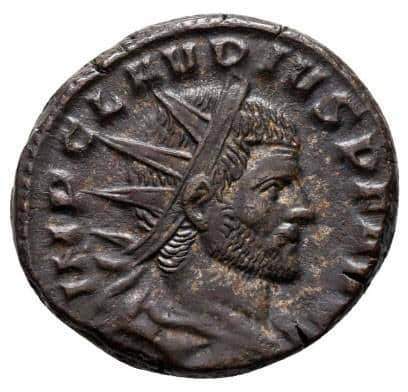
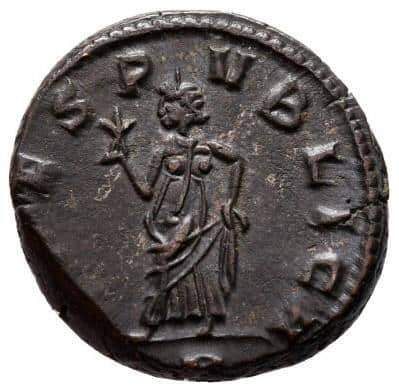
The Claudius II Gothicus “Public Hope” Antoninianus (RIC V 168) serves as a gritty silver-washed window into the “Age of the Soldier-Emperors.” Struck around AD 268–270, this coin was minted in Mediolanum (modern Milan) during a period of existential dread, when the Roman Empire was literally fighting for its survival against a tidal wave of Gothic invasions and internal breakaways.
At Numiscurio, we often say that a coin’s “soul” is found in the defiance of its imagery—when the world was falling apart, the mints didn’t just strike money; they struck a promise that better days were coming.
1. The Historical Context: The Hope of Milan
Claudius II, famously known as “Gothicus,” ascended to the throne at a moment of total crisis. The Gallic Empire had severed the West, Zenobia was consolidating the East, and a massive Gothic force was descending upon the Balkans. To stabilize the situation, Claudius established his primary military headquarters at Mediolanum, the strategic gateway to the Italian peninsula.
This coin was minted at that high-stakes Milanese hub. By invoking SPES PVBLICA (The Public Hope), Claudius was addressing a population that had forgotten what peace felt like. It was a piece of psychological warfare: a reminder that with a seasoned Illyrian general at the helm, the “Hope” of the Roman people was not just a dream, but a military objective.
2. The Reverse: Spes and the Flower of the Future
The reverse features Spes, the personification of Hope, draped and walking left. She holds a flower in her right hand and delicately raises the hem of her robe with her left.
- The Budding Flower: The flower Spes holds is a symbol of potential—the “bloom” of a new era that hasn’t yet fully opened. In the dark days of the 3rd century, this was a powerful metaphor for an Empire that hoped to blossom again after the “winter” of the crisis.
- The Walking Pose: Unlike the static, seated goddesses of earlier centuries, Spes is almost always shown in motion. She is walking toward the future, stepping lightly as if to avoid the ruins of the present.
- The Legend: SPES PVBLICA. This wasn’t just the Emperor’s hope; it was the “Public Hope.” It was a collective contract between the ruler and the ruled.
3. The Obverse: The Iron-Jawed General
The obverse features the radiate and draped bust of Claudius Gothicus, facing right.
- The Barracks Realism: Claudius was the first of the great “Illyrian” soldier-emperors who would eventually save the Empire. His portrait reflects this: the short, cropped “military” haircut, the rugged jawline, and the intense, weathered expression of a man who spent his life in the camps.
- The Pious and Happy Titles: The legend IMP CLAVDIVS P F AVG (Imperator Claudius Pius Felix Augustus) sought to wrap this tough general in the traditional cloak of Roman legitimacy.
- The Legend: IMP CLAVDIVS P F AVG.
4. Technical Details: The Mediolanum Strike
- RIC V 168: Cataloged in the fifth volume of Roman Imperial Coinage, which documents the fast-paced transitions of the late 3rd century.
- The Mint: Struck in Mediolanum. The Milanese style under Claudius is distinct for its “linear” and energetic engraving. You can see it in the sharp, zigzag folds of Spes’s gown and the specific, elongated rays of the radiate crown.
- The Billon Reality: By AD 268, the “silver” Antoninianus was mostly copper. These coins were given a “pickling” bath to create a thin, bright silver surface. Finding a specimen where this fragile silvering is still visible is a major highlight, as it shows the coin as it looked when it was first paid out to the elite cavalry units stationed in Milan.
