
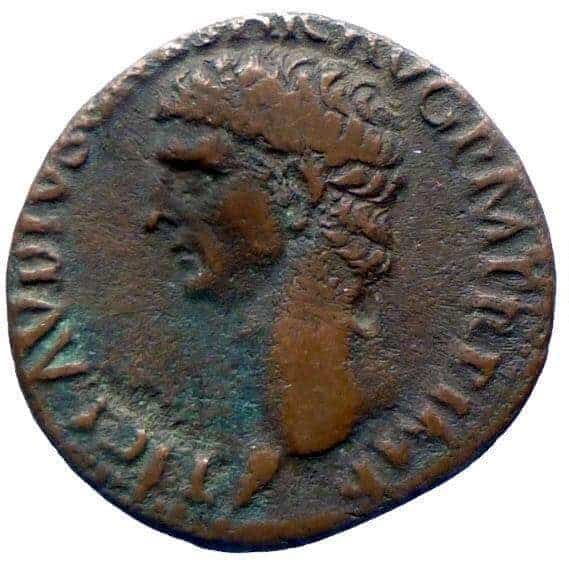
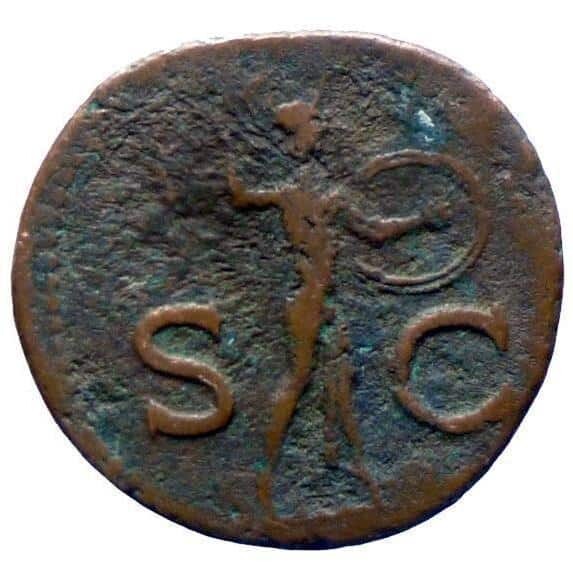
The Claudius I Dupondius (RIC 100) is a classic of the Early Empire, struck between AD 41 and 50. It is a coin that tells the story of an “accidental” emperor who used ancient Roman virtues to prove he was fit to rule after the chaotic and bloody assassination of his nephew, Caligula.
1. The Historical Context: The Scholar Emperor
When Claudius was found hiding behind a curtain in the palace while the Praetorian Guard was murdering Caligula, no one expected him to last. He was a scholar, a historian, and suffered from physical infirmities that led his own family to mock him.+1
However, Claudius proved to be a remarkably capable administrator. This Dupondius (a medium-value brass coin worth two Asses) was part of his effort to restore dignity to the Roman state. While Caligula had used coins for wild self-glorification, Claudius used them to emphasize stability, tradition, and military protection.
2. The Reverse: Minerva the Defender
The reverse features Minerva, the goddess of wisdom, war, and handicrafts, advancing right. She is heavily armed, brandishing a javelin and holding a round shield (ancile).
- Why Minerva? Minerva was the patron deity of scholars—a nod to Claudius’s own intellectual nature—but more importantly, she represented the defensive strength of the state.
- The Message: By choosing Minerva, Claudius was signaling that his reign would be guided by wisdom and a strong, disciplined military. It was a “return to basics” after the madness of the previous years.
- The “S C”: Like most brass and copper coins of this era, the reverse features a large S C (Senatus Consulto), indicating the Senate’s formal (if symbolic) approval of the coinage.
3. The Obverse: The Realistic Portrait
The obverse features the bare head of Claudius with the legend: TI CLAVDIVS CAESAR AVG P M TR P IMP.
- The Style: Claudius’s portraits are famously “veristic” (realistic). Unlike the idealized, god-like images of Augustus, Claudius allowed his coins to show his aging features, heavy jaw, and lined neck. This was a deliberate political choice to look like a serious, traditional Roman magistrate rather than a Hellenistic king.
- The Metal (Orichalcum): Dupondii were made of orichalcum, a golden-toned brass alloy. In antiquity, a fresh Dupondius looked like gold to the untrained eye, which made it a prestigious coin for the middle class and soldiers.
4. Technical Details & Rarity
- RIC 100: Cataloged in Roman Imperial Coinage, Volume I.
- The “Imitative” Issues: Interestingly, this specific Minerva type was so popular and needed in the provinces (especially Britain and Gaul) that many “contemporary counterfeits” or local imitations exist. A genuine Rome-mint specimen like RIC 100 is distinguished by its fine, sharp lettering and superior artistic style.
