
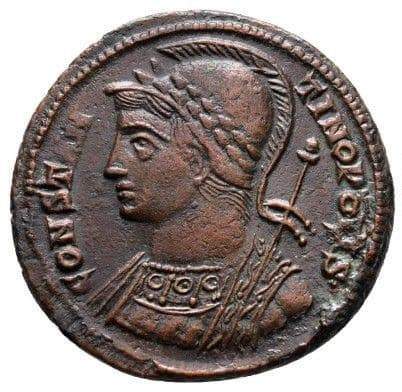
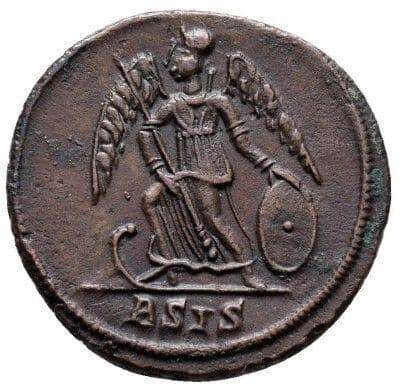
The Constantinopolis City Commemorative (RIC VII Siscia 224/241) serves as a striking bronze window into the architectural and spiritual birth of the “New Rome.” Struck around AD 330–335, this piece was part of a massive, Empire-wide propaganda campaign launched by Constantine the Great to celebrate the inauguration of his new capital, Constantinople, and to signal a definitive shift in the Roman world’s center of gravity.
1. The Historical Context: The Birth of Byzantium
By AD 330, Constantine had consolidated his power and made a radical decision: the old city of Rome, with its pagan baggage and stubborn Senate, was no longer the fit heart for his Christianized, unified Empire. He looked to the ancient Greek city of Byzantium on the Bosporus—a strategic gateway between East and West—and rebuilt it on a scale that rivaled the Eternal City itself.
This coin was the “birth certificate” of that city. Minted in massive quantities across all imperial workshops, including the vital military hub of Siscia, it ensured that every soldier and merchant from the Danube to the Nile knew that Constantinople was now the co-equal of Rome. It marks the precise transition from the Classical Roman era to the dawn of the Byzantine Empire.
Because these commemoratives were struck with high-quality dies to impress a global audience, they often feature incredible detail in the armor and the ship’s prow. Finding a Siscia specimen where the “reversed spear” on the obverse and the “Victory on the prow” on the reverse are both sharp is a cornerstone for any collection focusing on the Constantinian revolution.
2. The Reverse: Victory of the Waterways
The reverse features Victory (Victoria), winged and draped, standing left on a ship’s prow, holding a spear and resting her hand on a shield.
- The Queen of the Bosporus: The ship’s prow is not just a decorative element; it represents the maritime supremacy of the new capital. Constantinople’s power was built on its harbor, the Golden Horn, and its ability to control the trade routes between the Black Sea and the Mediterranean.
- The Guardian of the City: Unlike earlier Victory types that represented a specific battle, this Victory represents the eternal triumph of the city itself. She stands ready with spear and shield, acting as the divine sentinel of the new Roman headquarters.
- The Legend: Usually absent, as the imagery of the “New Rome” was so universally recognized that words were unnecessary.
3. The Obverse: The Personification of a Capital
The obverse features the helmeted and laureate bust of Constantinopolis, facing left, holding a reversed spear.
- The Warrior Queen: Constantinopolis is depicted as a blend of the goddess Roma and the goddess Athena. She wears a high-crested helmet and an imperial cloak, signaling that this city is not just a commercial hub, but a military fortress.
- The Reversed Spear: Holding the spear with the point down is a classic symbol of “Armed Peace.” It tells the viewer that while the city is at rest, its defenses are ready at a moment’s notice.
- The Legend: CONSTAN-TINOPOLIS. A direct, bold naming of the new mistress of the East.
4. Technical Details: The Siscia Excellence
- RIC VII Siscia: Cataloged in Roman Imperial Coinage, Volume VII, which covers the later reign of Constantine.
- The Mint: Struck in Siscia (modern-day Sisak, Croatia). The Siscia mint was a powerhouse of the 4th century, known for its sharp, high-relief strikes and deep, rich patinas. You can identify it by the mint mark in the exergue (e.g., BSIS, ΓSIS, or ASIS-star).
- The Commemorative Series: These coins were struck alongside the “Urbs Roma” types (featuring the she-wolf and twins). Together, they formed a pair that acknowledged the old tradition while crowning the new future.
