
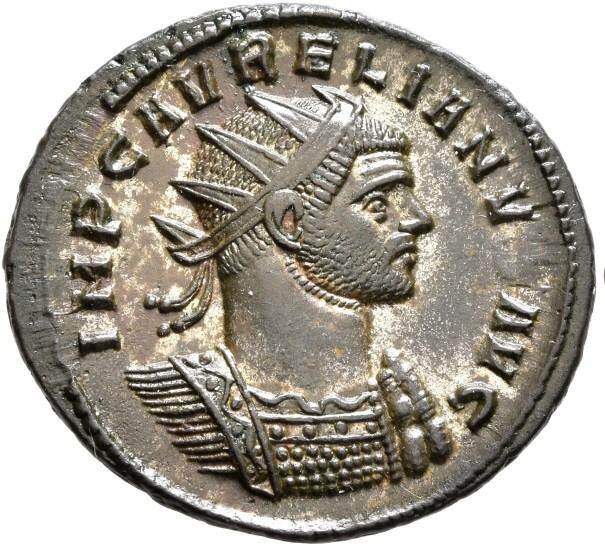
the Aurelian “Rising Sun of the East” Antoninianus (RIC V 151) serves as a powerful silver-washed window into the literal salvation of the Roman Empire. Struck between AD 274–275 in Ticinum (modern Pavia, Italy), this coin is a triumphant “mission accomplished” statement from the man the Senate officially titled Restitutor Orbis—the Restorer of the World.
At Numiscurio, we often say that a coin’s “soul” is found in the transition from chaos to order; to hold an Aurelian “Oriens” is to hold the moment the lights were turned back on in the Roman West.
1. The Historical Context: The Hand on the Sword
By AD 270, Rome was a fractured shadow of its former self. The Gallic Empire had stolen the West, and Queen Zenobia’s Palmyrene Empire had seized the East. Aurelian, a career soldier of legendary toughness, spent his brief five-year reign in a non-stop whirlwind of iron and blood.
This coin was minted following his spectacular defeat of Zenobia and the recapture of the wealthy Eastern provinces. The worn reverse die on this specimen is a fascinating historical artifact in itself—it speaks to the sheer volume and speed at which the Ticinum mint had to work to produce the millions of coins needed to pay the victorious legions and stabilize the newly reunited economy.
2. The Reverse: The Unconquered Sun
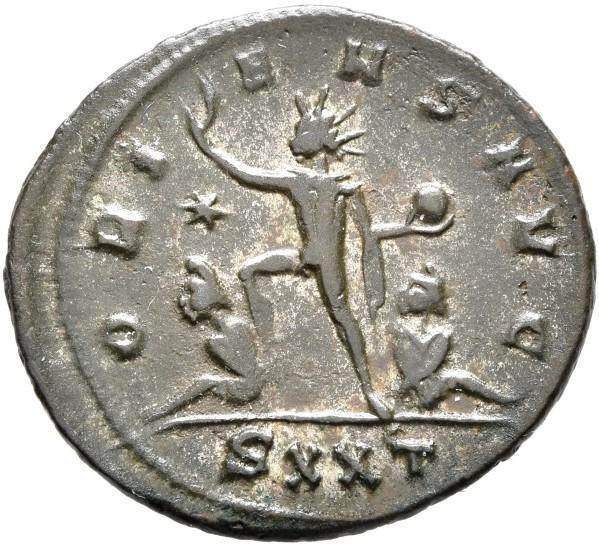
The reverse features Sol, the sun god, standing left, raising his right hand and holding a globe. At his feet sit two bound captives in “oriental” (Palmyrene/Persian) dress.
- The Solar Theology: Aurelian was the first Emperor to elevate Sol Invictus (The Unconquered Sun) to the level of the Empire’s supreme deity. He believed the Sun had personally guided him to victory in the East.
- The Captives of the East: The seated figures in pointed caps represent the defeated Palmyrene forces. Their presence at Sol’s feet was a blunt reminder to every Roman citizen: the rebellion is over, and the East belongs to Rome again.
- The Legend: ORIENS AVG. This translates to “The Rising Sun of the Augustus.” It signaled a new dawn for a Roman world that had been in the dark for nearly fifty years.
3. The Obverse: The Iron Emperor
The obverse features the radiate and cuirassed bust of Aurelian, facing right.
- The Military Prowess: Notice the sharp, angular features and the heavy cuirass (armor). Aurelian’s portraits are devoid of the “philosopher” look of earlier eras; he is depicted as a grim, focused general whose only interest was the defense of the state.
- The Great Reform: This coin was part of Aurelian’s massive currency reform. He improved the weight and silver content of the Antoninianus, marking them with the “XXI” (or “KA”) mark to guarantee their value.
- The Legend: IMP C AVRELIANVS AVG.
4. Technical Details: The Ticinum Craft
- RIC V 151: Cataloged in the fifth volume of Roman Imperial Coinage, which covers the era of the Illyrian soldier-emperors.
- The Mint: Struck in Ticinum. The Ticinum mint was established by Aurelian himself to support his campaigns in the North. It is known for its neat, compact lettering and a specific style of the radiate crown that feels more “vertical” than the Rome mint issues.
- The Star in the Field: The star in the left field is a series mark, helping the mint masters track different batches of production. In the context of the “Oriens” type, it also serves as a beautiful celestial nod to the solar theme of the coin.
