
The Aurelian “Jupiter the Conservator” Antoninianus (RIC V 225) is a heavy-hitting piece of military history struck between AD 272–274. Minted in Siscia (modern-day Sisak, Croatia), this coin was a critical tool in Aurelian’s campaign to glue the shattered Roman Empire back together. It captures the “Restorer of the World” at a moment of supreme theological transition, shifting the source of his power from the Senate’s floor to the heavens.
1. The Historical Context: The Iron General of Siscia
Aurelian was a career soldier from the Balkans, and Siscia was his backyard. As one of the most important military mints in the Empire, Siscia was responsible for striking the “paycheck of the legions” that Aurelian used to crush the Palmyrene Empire in the East and the Gallic Empire in the West.
The IOVI CONSER (Jupiter the Conservator/Preserver) legend was a calculated political move. In the 270s, the Empire was nearly dead. By featuring Jupiter—the traditional head of the Roman pantheon—Aurelian was signaling a return to “Old School” Roman values. He was telling the world that he wasn’t just a lucky general; he was the divinely appointed “Conservator” tasked by Jupiter himself to save the Roman way of life.
2. The Reverse: The Investiture of a Restorer
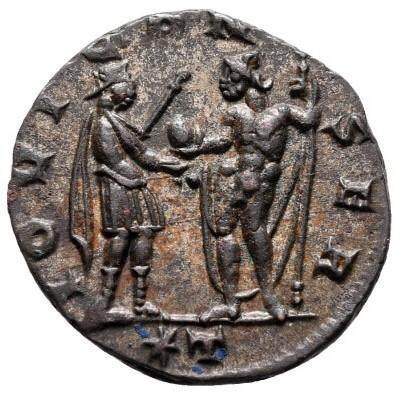
The reverse features a powerful scene of imperial investiture: Aurelian stands on the left, facing right, receiving a globe from Jupiter, who stands on the right holding a long scepter.
- The Globe of Authority: The globe represents the oikoumene (the civilized world). By receiving it directly from Jupiter, Aurelian bypassed the need for Senatorial approval. His right to rule was a gift from the heavens.
- The Scepter of Law: Jupiter’s long scepter represents the eternal law of the cosmos. It reminds the holder that while Aurelian holds the sword, the Gods hold the scales of justice.
- The Legend: IOVI CONSER. Short for Iovi Conservatori, a dedication to “Jupiter the Preserver.”
3. The Obverse: The Soldier-Emperor’s Gaze
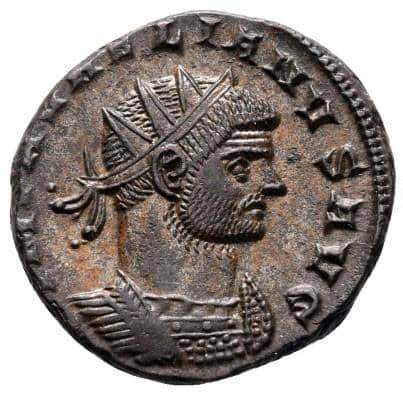
The obverse features the radiate, draped, and cuirassed bust of Aurelian, facing right.
- The Pannonian Style: The Siscia mint is famous for its distinct, rugged portrait style. Notice the sharp, almost “steely” features of Aurelian—the short-cropped military hair and the intense, focused expression.
- The Cuirass of Command: He is shown in his cuirass (armor), a reminder that Aurelian spent nearly his entire five-year reign on horseback, personally leading his troops from one end of the Empire to the other.
- The Legend: IMP AVRELIANVS AVG.
4. Technical Details: The Siscia Workshop
- RIC V 225: Cataloged in the fifth volume of Roman Imperial Coinage, documenting the era of the Illyrian Emperors.
- The Mintmark: The Star over T in the exergue is a classic Siscia signature. The “T” stands for Tertia (the third workshop or officina of the mint), while the star is a series mark used to track different batches of production.
- The “XXI” Standard: This coin was part of Aurelian’s massive currency reform. He increased the silver content and stabilized the weight of the Antoninianus, creating a “New Deal” for the Roman economy that would last until the time of Diocletian.
