
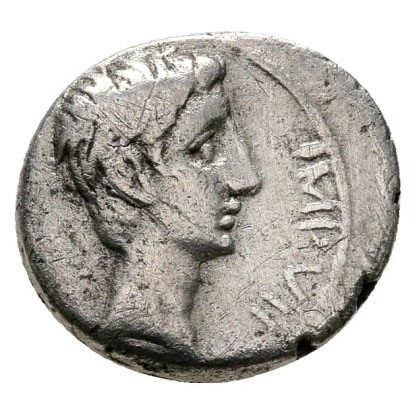
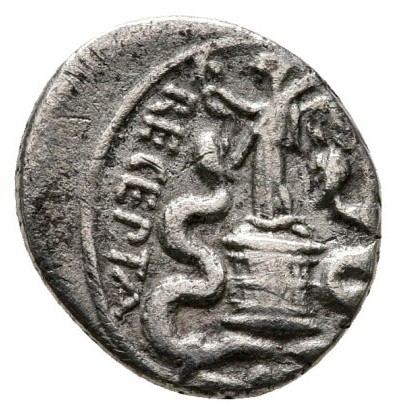
The Augustus “Asia Recepta” Quinarius (RIC I 276) is a masterpiece of political marketing struck in 29–28 BC. This coin doesn’t just represent currency; it represents the exact moment the Roman Republic died and the Empire was born. Struck in the immediate wake of the Battle of Actium, it celebrates the “recovery” of the Eastern provinces after the defeat of Mark Antony and Cleopatra.
1. The Historical Context: The Spoils of Egypt
In 30 BC, Octavian (the future Augustus) entered Alexandria. His rivals were dead, the Ptolemaic treasury was his, and the vast, wealthy provinces of the East were finally under his sole command.
The legend ASIA RECEPTA (“Asia Recovered”) was a stroke of genius. It avoided the “crass” boast of conquering a fellow Roman (Antony); instead, it framed the civil war as a successful mission to bring the Eastern territories back into the Roman fold. This coin was likely struck at an Italian or traveling military mint to pay the veterans of the Actium campaign, serving as a silver receipt for the peace Octavian had finally “restored” to the world.
2. The Reverse: Victory and the Mystic Cist
The reverse features Victory standing left on a cista mystica between two intertwined snakes.
- The Cista Mystica: This was a sacred basket used in the mystery cults of Dionysos, a symbol deeply associated with the “Cistophoric” silver coinage of the East. By placing Victory on top of it, Octavian was literally “standing on the traditions of the East,” signaling his mastery over the Greek and Asian provinces.
- The Two Snakes: In ancient symbolism, snakes were protectors of the earth and the spirits of the place (Genius Loci). Here, they rise from the basket to acknowledge the new Roman master of Asia.
- The Legend: ASIA RECEPTA. It is a short, punchy, and unshakeable statement of fact.
3. The Obverse: The Young Imperator
The obverse features the bare head of Octavian, facing right.
- The Pre-Augustan Look: Notice that he is not yet “Augustus.” He is still portrayed with the lean, youthful, and slightly hungry look of a revolutionary leader. He has not yet adopted the “heavenward gaze” or the divine honors that would define his later portraits.
- The Title: CAESAR IMP VII (Caesar Imperator VII). This marks his seventh imperial acclamation, a title awarded by his soldiers for his military successes. It emphasizes his role as a commander before his role as a princeps.
4. Technical Details: The Silver Half-Denarius
- The Denomination: The Quinarius was worth half a Denarius. Because of its smaller size, it was often used for special donatives or religious offerings.
- The Strike: These coins are often found with a slightly “toggled” or off-center strike, but finding one where the scales on the snakes or the feathers of Victory’s wings are visible is a major highlight for any collector of the Imperatorial era.
- The Toning: Silver quinarii from this period often develop a beautiful, iridescent “rainbow” toning or a deep, “gunmetal” grey.
