
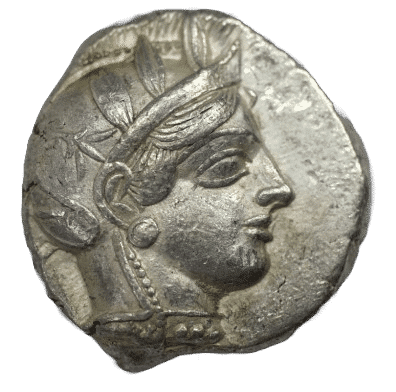

If there is a “holy grail” for every ancient coin collector, the Athenian Owl Tetradrachm (Kroll 8; HGC 4, 1597) is it. This wasn’t just money; it was the “Dollar of Antiquity.” For over 400 years, this silver heavy-hitter was the undisputed king of Mediterranean trade, accepted from the pillars of Hercules to the edges of India.
But the story behind the “Classical Owl” (minted roughly 454–404 BC) is one of a city-state at its most arrogant, brilliant, and ultimately, its most desperate.
1. The Silver Mountains of Laurion
The story of the Owl begins underground. South of Athens lay the Laurion silver mines. In 483 BC, a massive new vein of silver was discovered. While many Athenians wanted to split the profits, the visionary leader Themistocles convinced them to build a massive fleet of triremes instead.+1
That silver—and the ships it built—defeated the Persian Empire at the Battle of Salamis. From that moment on, the Owl became a symbol of a superpower. Every coin you hold from this era was likely mined by candlelight in those cramped, dangerous tunnels by thousands of enslaved laborers to fuel the “Golden Age of Pericles.”
2. The Obverse: Athena’s “Archaic” Smile
The obverse features the helmeted head of Athena, the patron goddess of the city.
- The Artistic Paradox: By 450 BC, Greek sculpture was becoming incredibly lifelike (think of the Parthenon statues). Yet, the coins kept an “archaic” style—Athena’s eye is shown frontally (as if looking at you) even though her face is in profile.
- The Brand Trust: Athens refused to modernize the design because the “Owl” was such a trusted “brand.” Merchants in Egypt or Persia didn’t want a “new” looking coin; they wanted the familiar, clunky, archaic face they knew was pure silver.
3. The Reverse: The Owl and the “AOE”
On the reverse, we find the iconic Little Owl (Athene noctua).
- The Sprig of Olive: Next to the owl is a small olive sprig—a reminder of Athena’s gift to the city and the source of Athens’ agricultural wealth.
- The Crescent Moon: There is a tiny crescent moon behind the owl’s shoulder. Legend says it commemorates the Battle of Marathon, fought under a waning moon.
- AOE (Alpha-Theta-Epsilon): This stands for ATHE-NAION, “Of the Athenians.” It was a proud declaration of ownership.
4. The “Test Cut” and the War Machine
If you find an Owl with a deep gash in it, don’t be disappointed! These are “Test Cuts.” Because the Owl was so valuable, ancient forgers would often plate copper in a thin layer of silver. Merchants would hack into the coin with a chisel to ensure it was solid silver all the way through.
These coins paid for the building of the Parthenon, the plays of Sophocles, and the philosophy of Socrates. But they also paid for the disastrous Peloponnesian War. By the end of the 5th century BC, Athens was so broke that they began melting down the gold statues of Victory (Nike) to make emergency coins, signaling the end of the Owl’s golden reign.
