
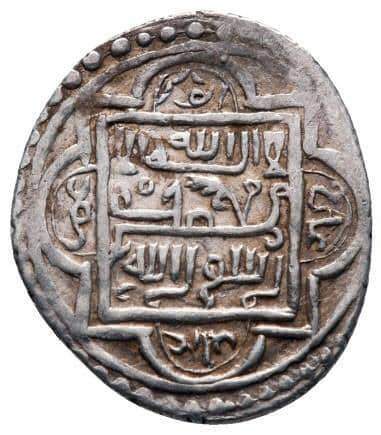
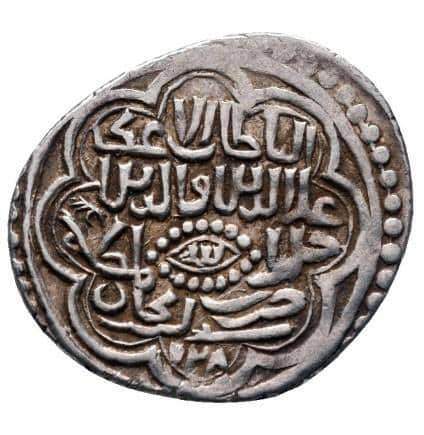
The Ali Beg Silver Akce (Eretnid Beylik, AD 1366–1380) is a rare and mathematically beautiful specimen from the “Age of the Beyliks.” Struck in Central Anatolia, this coin represents the fascinating, fragmented world that emerged after the collapse of the Mongol Ilkhanate. It is a masterpiece of Islamic geometry, reflecting a time when local warlords used silver and faith to carve out their own sovereign identities.
At Numiscurio, we often say that an Akce is a “silent witness” to the transition of power; while the Ottomans were eventually destined to unite Anatolia, the Eretnids were once the undisputed masters of the high plateaus of Sivas and Kayseri.
1. The Historical Context: The Successors of the Mongols
The Eretnids were of Uyghur Mongol origin, originally serving as governors for the Ilkhanate. When the Mongol central power dissolved in the mid-14th century, the Eretnid state became an independent Beylik. Ali Beg, the grandson of the dynasty’s founder, ruled during a period of intense rivalry between the emerging Ottoman state to the West and the Jalayirids to the East.
By striking this silver Akce, Ali Beg was exercising the Sikka—the right to mint coinage—which was the ultimate declaration of independence in the medieval Islamic world. These coins didn’t just facilitate trade along the Silk Road branches in Anatolia; they served as a silver “broadcast” of Ali Beg’s legitimacy as a Great Sultan (al-sultān al-a’zam).
2. The Obverse: The Shield of Faith
The obverse is a stunning example of Anatolian geometric art. Inside a square within a looped square, we find the central creed of Islam: the Kalima.
- The Central Legend: lā ilāha illā Allāh – Muhammad – rasūl Allah (“There is no god but Allah, Muhammad is the messenger of Allah”).
- The Four Caliphs: In the delicate loops at the corners of the square, the names of the Rashidun (the “Rightly Guided” Caliphs) are inscribed: Abū Bakr, ’Umar, ’Uthman, and ’Ali.
- The Symbolic Geometry: The use of the looped square was not just decorative; it symbolized the interconnectedness of the faith and the state, a common motif in the architectural tilework of Eretnid mosques and madrasas in Sivas.
3. The Reverse: The Sultan’s Mandate
The reverse features an incredibly creative calligraphic layout, centering on an eye-shaped frame (or almond-shaped mandorla) that houses the word Allah.
- The Imperial Title: The legend reads al-sultān al-a’zam, ‘alā al-dunyā wa’l-dïn (“The Supreme Sultan, Excellence of the World and of the Faith”). This is a grand, high-status title designed to place Ali Beg on par with the great Mamluk and Persian rulers of his day.
- The Royal Prayer: It concludes with the phrase khallada Allāh mulkahu (“May Allah make his kingdom eternal”).
- The Eye of the Design: The way the word “Allah” is incorporated into the eye-shaped frame is a hallmark of Eretnid numismatic art, showing a high level of sophistication in the Kayseri and Sivas mints.
4. Technical Details: The Anatolian Silver
- The Denomination: This is an Akce, the standard silver unit of the Anatolian Beyliks. It is the direct ancestor of the Ottoman Akce that would dominate Mediterranean trade for centuries.
- The Mint: Likely struck in Sivas or Kayseri, the twin hearts of the Eretnid state. These cities were major hubs on the trade routes connecting the Black Sea to the Persian Gulf.
- The Strike: Eretnid silver is known for its thin, broad flans and sharp, angular calligraphy.
- The Collector’s “Tell”: Look for the clarity of the loops in the square on the obverse. Because these were struck with handheld dies, finding a specimen where the names of the Four Caliphs are not “flat” or clipped is a major find for a specialist of the Anatolian Beyliks.
