
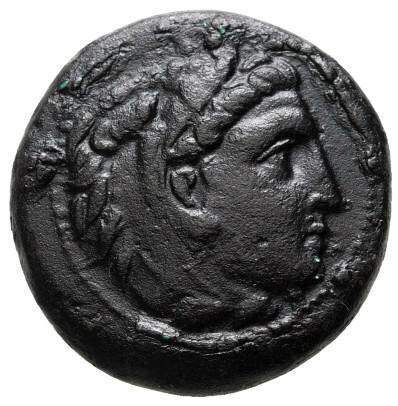
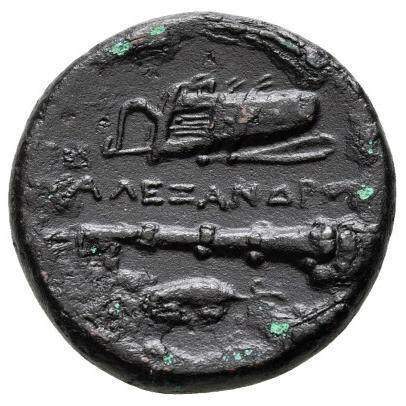
The Alexander III “the Great” Bronze (Price 301) is a rugged, tactile piece of the greatest military expansion in human history. Struck between 336–323 BC—likely at a Macedonian mint like Pella or Amphipolis—this coin was the “pocket change” of the empire-builders. While his silver tetradrachms paid the generals, these bronze units (often called units or chalkoi) were the coins that traveled in the leather pouches of the phalanx, buying grain, wine, and passage from the Adriatic to the Indus.
1. The Historical Context: The Face of a Legend
When Alexander III took the throne at age 20, he didn’t just inherit a kingdom; he inherited the ambition to unite the East and West. This coin was part of his massive logistical effort to standardize the economy of his rapidly growing empire.
By depicting Herakles on the obverse, Alexander was doing more than honoring a god. The Argead royal house of Macedon claimed direct descent from Herakles himself. This coin served as a constant reminder to his subjects and his soldiers that their king wasn’t just a man—he was of the blood of the greatest hero in Greek mythology.
2. The Obverse: The Lion-Slayer
The obverse features the Head of Herakles, facing right, wearing the Leonté (the skin of the Nemean Lion).
- The Mask of Power: The lion’s scalp is pulled over Herakles’ head, with the paws tied beneath his chin. This imagery was so potent that for centuries after Alexander’s death, almost every Hellenistic king tried to mimic this “Herakles look” on their own coins.
- The Alexander “Selfie”: Interestingly, many numismatists believe that as Alexander’s reign progressed, the features of Herakles on the coins began to take on the actual facial characteristics of Alexander himself—a subtle way of blending the king with the god.
3. The Reverse: The Weapons of a Hero
The reverse features the signature “Tools of the Trade” for a Macedonian warrior: a Club positioned above a Quiver-over-Bow.
- The Club of Strength: This is the primary weapon of Herakles, representing raw, physical power.
- The Bow and Quiver: These symbolize the reach and precision of the Macedonian army. Alexander was a master of combined arms, and the bow was essential for the skirmishers and light infantry that supported the heavy phalanx.
- The Legend: Usually features the name ΑΛΕΞΑΝΔΡΟΥ (Of Alexander), marking the coin as the official property of the king.
4. Technical Details: The Price Reference
- Price 301: Cataloged in Martin Price’s definitive work, The Coinage in the Name of Alexander the Great. This specific reference helps identify the precise minting style and period of the issue.
- The Metal: Bronze (AE). Unlike silver, which was valued for its weight, these bronze coins were “fiduciary,” meaning their value was backed by the authority of the King’s word.
- The Patina: These Macedonian bronzes are famous for their “bottle green” or deep, earthy “desert” patinas. Finding a specimen where the individual scales of the quiver or the teeth of the lion skin are still sharp is a highlight for any collector of the Hellenistic age.
